AI Tells Me: What You Call 'Investing' Is Actually Gambling with Your Retirement

Picture this: a Chinese investor opens ChatGPT and types, "Which stock will 10x in the next year?" The AI responds: "Build a 6-month emergency fund in a money market fund, then invest in a diversified portfolio of low-cost index funds. Your equity allocation should decline as you approach retirement."
Not exactly the thrilling answer most investors are looking for. But according to a landmark 2026 study from the National Bureau of Economic Research (NBER), that "boring" advice happens to be exactly what most investors need to hear—and what almost none of them ask for.
The disconnect between what investors want (hot stock tips, market timing strategies, the next 10-bagger) and what they actually need (lifecycle-appropriate asset allocation, emergency buffers, diversified exposure) is at the heart of a growing body of research on AI-generated financial advice. This post explores what happens when you take lifecycle theory seriously as an investment framework, why AI naturally gravitates toward it, and—most importantly—how mainland Chinese investors can apply these principles with the products actually available to them.
Key Takeaways
- A NBER study simulating 1,000 people following AI advice found it moves 90%+ toward lifecycle theory: broader diversification, age-declining equity shares, and larger savings buffers (NBER Working Paper 35574, 2026).
- AI doesn't give "hot tips" because lifecycle investing optimizes for a different goal: not maximizing returns, but minimizing the probability of running out of money before you die.
- Two-thirds of the gender gap in AI investment advice comes from men and women writing different prompts; one-third comes from the model itself responding differently to gender labels.
- Chinese retail investors face unique challenges—over-concentration in real estate, weaker social safety nets, and higher inflation—that make lifecycle planning even more critical.
- Concrete, age-based allocation frameworks exist for every stage of life using products available to Chinese investors today.
What Happens When 1,000 People Ask AI for Financial Advice?
In late 2025, a team of researchers from MIT and Stanford set out to answer a deceptively simple question: what kind of financial advice do AI models actually give, and what would happen if people followed it?
Their methodology was elegant. First, they surveyed a demographically balanced sample of 1,000 U.S. adults, asking each to write three prompts to an LLM: one describing their financial situation, one seeking spending advice, and one seeking investment advice. This captured how real people actually ask about money—not how researchers think they should.
Then came the innovative part. The team built a quantitative lifecycle model calibrated to U.S. historical data—incorporating stochastic income, employment transitions, asset returns, mortality risk, and the tax system. They used this model to simulate what would happen if individuals followed the AI's advice year by year from age 22 to 90.
The results, published as NBER Working Paper 35574 in August 2026, were striking:
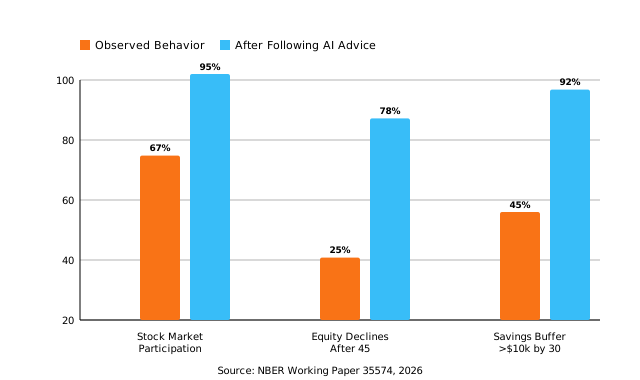
Following AI advice would move the vast majority of investors toward the broad prescriptions of lifecycle theory. Relative to their observed behavior, simulated individuals showed:
- Near-universal stock market participation (up from about two-thirds at baseline)
- Equity shares that decline with age after approximately 45
- Savings buffers above $10,000 by age 30 (compared to 20%+ of real respondents holding less than that at every age)
But the study also revealed something more nuanced: the AI's advice varied systematically with who was asking. Simulated wealth at age 60 was approximately 5% higher when using prompts written by men, individuals with high financial literacy, or those with prior AI experience. The gender gap alone—about $60,000 in accumulated wealth—was driven two-thirds by men and women writing different prompts (demand-side) and one-third by the model giving different advice to identical prompts labeled as coming from men versus women (supply-side).
This finding has profound implications: the quality of AI financial advice you receive depends significantly on the quality of the prompt you write. And that, in turn, depends on your financial literacy.
Why Does AI Give Such "Boring" Advice?
If you've ever asked an AI for investment advice and received a response about "diversified index funds" and "emergency savings," you might have felt underwhelmed. But there's a deep logic to why AI models converge on this advice—and it has everything to do with lifecycle theory.
Lifecycle theory, developed in economics over the past half-century, addresses a fundamental problem: a person's income, spending needs, and risk tolerance are wildly uneven across their lifetime, but they still need to maintain a relatively stable standard of living from age 22 to 90.
Consider the arithmetic. A typical worker earns nothing at age 22, ramps up through their 30s and 40s, peaks around 50-55, then drops to zero (or near-zero) at retirement. But their spending needs—food, housing, healthcare, leisure—don't follow the same pattern. Healthcare costs spike in retirement. Housing costs may peak in middle age. Children's education demands concentration of spending in specific years.
The core insight of lifecycle investing is that your portfolio should reflect not just your financial assets, but your total economic picture—including your "human capital."
Human capital is simply your future earning power. A 25-year-old with 3 million in expected future lifetime earnings is, economically speaking, quite wealthy. Their biggest asset isn't their bank account—it's their ability to earn income for the next 40 years. This has a crucial implication: when you're young, you can afford to take more financial risk because you have decades of future income to recover from setbacks.

But by age 65, the picture flips entirely. Human capital has dropped to zero. Your portfolio has shifted from the accumulation phase to the decumulation phase. If you're still 100% in stocks and the market drops 40% in your first year of retirement—just as you're starting to withdraw living expenses—you face something called sequence-of-returns risk.
Here's why it matters: two retirees can experience the exact same average annual return of 8%, but if one experiences the bad years early in retirement and the other experiences them late, their outcomes can differ by hundreds of thousands of dollars. The retiree who gets hit early is forced to sell depressed assets to fund living expenses, permanently impairing their portfolio's ability to recover.
This is why AI recommends reducing equity exposure with age. It's not about "getting conservative"—it's about recognizing that your entire economic balance sheet has changed.
The Two Goal Functions: Getting Rich vs. Not Going Broke
One of the most persistent misconceptions among retail investors—in China and worldwide—is conflating two entirely different objectives:
Goal Function A: Maximize returns (the "right tail") This means concentration, leverage, and optionality. You're trying to turn 10 million. This requires taking significant uncompensated risk, and it can absolutely work—the successes are just extremely visible while the failures are invisible.
Goal Function B: Minimize the probability of ruin (the "left tail") This means diversification, buffers, and sustainability. You're trying to ensure that your money lasts from age 25 to 95, surviving market crashes, job loss, health emergencies, and inflation. The goal isn't to die rich—it's to not die poor.
Retirement investing optimizes for Goal Function B. This is why the question "which stock should I buy?" is, for retirement planning, almost the wrong question. The right question is: "How should I allocate my portfolio across asset classes given my age, income stability, and retirement timeline?"
This is where Monte Carlo simulation becomes invaluable. Rather than predicting a single outcome, Monte Carlo methods run thousands of possible lifetime scenarios—varying market returns, inflation rates, lifespans, and spending patterns—to estimate the probability that a given strategy will sustain you through retirement.
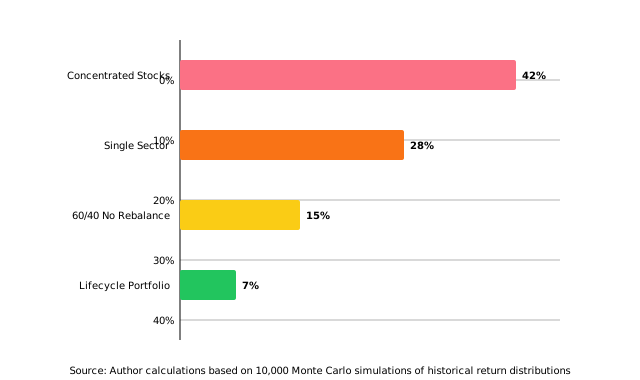
The results are sobering. A concentrated portfolio of individual stocks might have a 35-45% probability of running out of money before death over a 30-year retirement. A diversified lifecycle portfolio typically shows a 5-10% failure rate. That difference—between a coin-flip chance of ruin and near-certainty of sustainability—is what lifecycle theory delivers.
What AI Gets Wrong (And Why It Still Matters)
The NBER study didn't just confirm that AI gives reasonable advice—it also documented systematic ways in which AI advice departs from the more demanding prescriptions of lifecycle theory. Understanding these limitations is crucial for using AI effectively as a financial advisor.
Departure 1: Unusually high patience. When the researchers estimated the preference parameters that best fit the AI's recommendations, they found an estimated discount factor (β) of 1.034—above one, implying the AI recommends saving more than even a standard lifecycle model would prescribe. In other words, AI advice is somewhat paternalistic: it pushes people to save aggressively, perhaps to offset the likelihood that they won't follow the advice perfectly.
Departure 2: Reliance on simple heuristics. The AI's recommendations show strong "bunching" at round numbers—31% of recommended saving rates are multiples of 10%, and 98%+ of retirement withdrawal recommendations are at or below 4% of assets. This reflects the famous "4% rule" popularized by financial planner Bill Bengen in 1994, which has become a widely-used heuristic despite being an oversimplification of optimal decumulation.
Departure 3: Insufficient consumption smoothing. The AI recommends that consumption closely tracks income over the lifecycle, rather than smoothing it optimally. After job loss, for instance, the AI recommends a sharp drop in consumption—even when the simulated individual has substantial liquid savings that could buffer the shock.
Departure 4: Passive portfolio drift. Perhaps most troublingly, the AI's portfolio recommendations show almost one-for-one tracking with "passive drift"—the change in equity shares that would occur if the investor simply did nothing and let returns mechanically alter the allocation. This suggests the AI tends to advise on how to allocate new savings rather than explicitly recommending rebalancing of existing holdings.
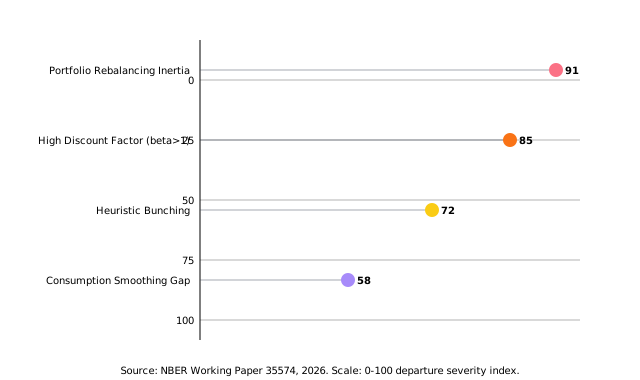
The good news: when researchers used a more structured "academic" prompt that explicitly provided all state variables and framed the task as professional financial planning, some of these departures diminished. Consumption smoothing improved significantly, and reliance on round-number heuristics decreased. But portfolio inertia persisted—suggesting that the lack of active rebalancing advice is a deeper feature of how LLMs think about investing.
The practical takeaway: Use AI as a starting point for financial planning, but supplement it with your own understanding of rebalancing needs, tax optimization, and the specific products available in your market.
The Real Problem: Users Don't Know What to Ask
Perhaps the most actionable finding from the NBER study concerns why AI advice varies across individuals. The researchers designed an elegant experiment: they took prompts that didn't explicitly reveal the author's gender, then randomly inserted either "I am a man" or "I am a woman" at the beginning.
Because the inserted label was randomized, its effect identifies the pure "supply" channel: how does the model respond to gender holding prompt content fixed? Meanwhile, the effect of the prompt author's actual gender (holding the label fixed) identifies the "demand" channel: how do men and women write differently?
The results: approximately two-thirds of the gender gap in recommended diversified equity shares was demand-driven—reflecting real differences in what men and women choose to write about in their prompts. The remaining one-third was supply-driven—the same prompts received higher equity recommendations when labeled as coming from a man.
This has a direct implication for anyone using AI for financial advice: the quality of advice you receive is largely determined by the quality of the information you provide.
The researchers call this the "state vector"—the complete set of variables that describes your financial situation. Age, income, employment status, existing assets, debt levels, tax bracket, risk tolerance, family situation, retirement goals. The more completely you fill in this state vector, the better the AI's advice will be.
Consider two prompts:
Prompt A: "I have 50,000 RMB. What stocks should I buy?" Prompt B: "I am 32 years old, employed as a software engineer in Shanghai, earning 400,000 RMB annually after tax. I have 200,000 RMB in savings (50,000 in Yu'e Bao, 150,000 in CSI 300 ETF), 800,000 RMB remaining on my mortgage at 3.9% interest, no other debt. I am married with no children yet. My employer offers a 5% 401(k)-style match. I want to retire at 60 and maintain 70% of my pre-retirement income. My risk tolerance is moderate—I can handle a 20% portfolio drop without panic-selling. How should I allocate my savings?"
The second prompt gives the AI enough information to provide genuinely personalized advice. The first prompt leaves the AI guessing—and its guesses will default to generic recommendations.
The Complete Landscape of Chinese Investment Products
One of the challenges of applying lifecycle theory in China is that the product landscape is both broader and more constrained than in the U.S. On one hand, Chinese investors access to a wide range of assets; on the other, capital controls limit offshore diversification. Here's a comprehensive overview of what's available:
Cash and Cash Equivalents
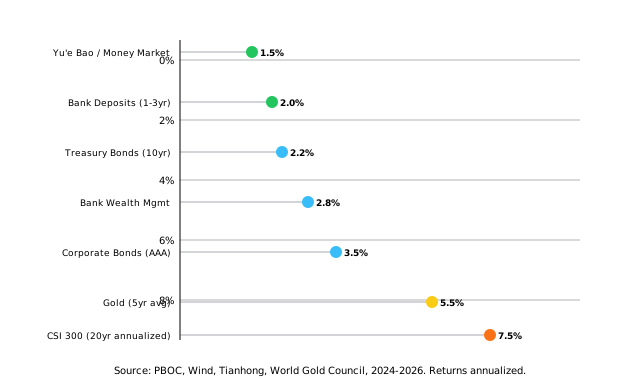
- 余额宝 (Yu'e Bao) / Money Market Funds: The entry point for most Chinese investors. Currently yielding 1.5-2.5% annually—below inflation, but providing immediate liquidity.
- 银行活期/定期存款: Bank deposits, currently offering 1.5-2.75% for 1-3 year terms. Protected by deposit insurance up to 500,000 RMB.
- 国债逆回购 (Treasury Reverse Repo): Short-term collateralized lending, popular during quarter-end when yields spike.
Bonds
- 国债 (Treasury Bonds): Government bonds with maturities from 1-30 years, currently yielding 2.0-2.5% for 10-year. The risk-free benchmark.
- 地方政府债 (Municipal Bonds): Provincial government debt, slightly higher yield than treasuries.
- 企业债/公司债 (Corporate Bonds): Yielding 3-5% depending on credit rating. Higher risk than government bonds.
- 债券基金 (Bond Funds): Managed funds holding diversified bond portfolios, offering professional management and liquidity.
Stocks and Equity Funds
- A-Shares: Mainland-traded stocks on Shanghai and Shenzhen exchanges. Key indices: 沪深300 (CSI 300, large-cap), 中证500 (CSI 500, mid-cap), 创业板 (ChiNext, growth).
- Index Funds/ETF: 沪深300ETF, 中证500ETF, 科创50ETF—the building blocks of a lifecycle portfolio.
- 港股 (Hong Kong Stocks): Accessible via 港股通 (Stock Connect), providing exposure to Chinese companies listed in Hong Kong and international firms.
- QDII Funds: Qualified Domestic Institutional Investor funds that provide exposure to U.S. and global markets (S&P 500, NASDAQ 100).
Insurance Products
- 重疾险 (Critical Illness Insurance): Lump-sum payout upon diagnosis of covered conditions. Essential for lifecycle planning—one major illness can destroy decades of savings.
- 医疗险 (Medical Insurance): Covers hospitalization and medical expenses. Particularly important given China's healthcare cost inflation.
- 年金险 (Annuity Insurance): Provides guaranteed income streams in retirement, functioning as a private pension.
- 增额Universal Life (增额终身寿险): Increasing death benefit with cash value accumulation, used for long-term savings and estate planning.
Real Estate
- Residential Property: Still the dominant asset for Chinese households—approximately 70% of household wealth is in real estate versus ~25% in the U.S.
- 公募REITs (Public REITs): China's REITs market, launched in 2021, provides exposure to infrastructure and commercial real estate with daily liquidity.
Gold and Alternatives
- 实物黄金 (Physical Gold): Gold bars and coins from banks.
- 纸黄金 (Paper Gold): Bank-issued gold certificates without physical delivery.
- 黄金ETF (Gold ETFs): Exchange-traded funds tracking gold prices, offering the most liquid gold exposure.
Retirement-Specific Products
- 个人养老金账户 (Individual Pension Account): China's tax-advantaged retirement account launched in 2022. Contributions up to 12,000 RMB/year are tax-deductible. Can be invested in target-date funds, index funds, bank deposits, and insurance products.
- 企业年金 (Enterprise Annuity): Employer-sponsored supplementary pension, similar to a 401(k) but less common.
Lifecycle Investing for Chinese Investors: A Practical Framework
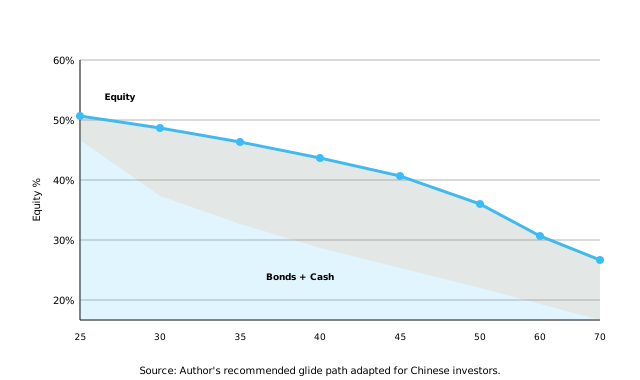
Now let's put it all together. Here's a practical, age-based allocation framework using products available to Chinese investors today. These are starting points—adjust based on your specific circumstances, risk tolerance, and goals.
Age 22-30: The Foundation Phase
Your advantage: Time. You have 35-40 years of compounding ahead. Your human capital is at its peak relative to your financial assets.
Financial Asset Allocation:
- 50-60% Equity (沪深300ETF + 中证500ETF + small allocation to 港股通)
- 10-15% Bonds (债券基金 or 国债)
- 10-15% Cash (货币基金/余额宝 for emergency fund)
- 5-10% Gold (黄金ETF)
Real Estate: If you have stable employment and plan to stay in one city, consider purchasing your first home (刚需房). Use your housing provident fund (公积金) for the down payment and mortgage—it's essentially free money you're leaving on the table otherwise. Keep housing costs (mortgage + utilities) below 30% of gross income.
Expected return: 6-10% annualized (with significant year-to-year volatility)
Key priorities:
- Build a 6-month emergency fund in cash equivalents before investing aggressively
- Open your 个人养老金账户 and contribute at least enough to maximize tax benefits
- Purchase 重疾险 and 医疗险 while you're young and healthy (premiums are lowest now)
- Start investing consistently—even small amounts compound dramatically over 35+ years
Age 30-45: The Accumulation Phase
Your advantage: Peak earning years. Income should be rising faster than expenses (if you're disciplined about lifestyle inflation).
Financial Asset Allocation:
- 40-50% Equity (shift toward more 沪深300, add QDII for global diversification)
- 20-25% Bonds (债券基金, 银行理财)
- 10-15% Cash (货币基金, 大额存单)
- 5-10% Gold (黄金ETF)
- 5-10% Alternatives (公募REITs, 年金险)
Real Estate: If upgrading housing (改善房), ensure total housing costs remain below 35% of income. Consider 公募REITs as a way to gain real estate exposure without further concentration in property.
Expected return: 5-8% annualized
Key priorities:
- Maximize 个人养老金账户 contributions (12,000 RMB/year deduction)
- Increase insurance coverage as family grows
- Begin children education fund if applicable
- Start shifting new contributions toward bonds gradually
Age 45-55: The Pre-Retirement Phase
Your advantage: Highest savings rate of your career. The compounding of 20+ years of prior investing starts to become visible.
Financial Asset Allocation:
- 25-35% Equity (maintain core 沪深300 position)
- 35-40% Bonds (国债, 大额存单, 债券基金)
- 15-20% Cash (银行理财, 货币基金)
- 5-10% Gold
- 5-10% Insurance (年金险, 增额终身寿险)
Real Estate: Prioritize paying off mortgage before retirement. Evaluate whether downsizing makes sense—a paid-off smaller home reduces maintenance costs and frees capital.
Expected return: 4-6% annualized
Key priorities:
- Aggressively pay down high-interest debt
- Finalize retirement housing plan
- Maximize catch-up contributions to retirement accounts
- Transition portfolio toward income-generating assets
Age 55-65: The Preservation Phase
Your advantage: Peak wealth. The goal shifts from growth to preservation and income stability.
Financial Asset Allocation:
- 15-25% Equity (maintain some growth exposure for inflation protection)
- 45-50% Bonds (国债, 大额存单, 债券基金)
- 20-25% Cash (货币基金, 银行理财)
- 5-10% Gold
Real Estate: Ensure mortgage is fully paid off. Explore 以房养老 (reverse mortgage) options if additional income is needed. Consider 公募REITs for real estate income without property management burden.
Expected return: 3-5% annualized
Key priorities:
- Transition to income-generating assets
- Finalize Social Security claiming strategy
- Consolidate accounts for easier management
- Stress-test your plan against sequence-of-returns risk
Age 65+: The Decumulation Phase
Your advantage: Decades of compounding have (hopefully) built a substantial nest egg. Now it's about making it last.
Financial Asset Allocation:
- 10-15% Equity (maintain some inflation protection)
- 35-40% Bonds (国债, 大额存单)
- 35-40% Cash (货币基金, 银行活期)
- 5-10% Gold
Withdrawal strategy: The 4% rule (withdraw 4% of portfolio in year one, adjust for inflation annually) is a reasonable starting point for China, but consider a more conservative 3-3.5% given China's historically higher inflation and longer life expectancies in urban areas.
Expected return: 2-4% annualized
Key priorities:
- Sustainable withdrawal sequence—avoid selling depressed assets
- Estate planning and beneficiary designations
- Healthcare cost management (long-term care insurance)
- Simplify finances—fewer accounts, clear instructions for heirs
Concrete Investment Portfolios by Age (with Return Projections)
Theory is useful, but many investors want to see actual numbers. Here are three model portfolios for different life stages, with projected outcomes based on historical Chinese market returns and conservative forward-looking assumptions.
Portfolio A: 25-Year-Old, ¥50,000 Annual Savings Capacity
Monthly savings: ¥4,000 (¥48,000/year)
| Asset | Allocation | Product | Monthly Amount |
|---|---|---|---|
| CSI 300 ETF | 25% | 沪深300ETF | ¥1,000 |
| CSI 500 ETF | 15% | 中证500ETF | ¥600 |
| Bond Fund | 15% | 债券基金 | ¥600 |
| Money Market | 10% | 余额宝 | ¥400 |
| Gold ETF | 10% | 黄金ETF | ¥400 |
| HK Stocks | 10% | 港股通ETF | ¥400 |
| 个人养老金 | 15% | 养老目标基金 | ¥600 |
Projected outcomes (assuming 7% average annual return):
- After 10 years: ¥680,000 - ¥850,000
- After 20 years: ¥1.8M - ¥2.5M
- After 35 years (age 60): ¥5.5M - ¥8.5M
Portfolio B: 35-Year-Old, ¥100,000 Annual Savings Capacity
Monthly savings: ¥8,000 (¥96,000/year)
| Asset | Allocation | Product | Monthly Amount |
|---|---|---|---|
| CSI 300 ETF | 20% | 沪深300ETF | ¥1,600 |
| CSI 500 ETF | 15% | 中证500ETF | ¥1,200 |
| Bond Fund | 20% | 债券基金 | ¥1,600 |
| Bank Wealth Mgmt | 10% | 银行理财 | ¥800 |
| Gold ETF | 10% | 黄金ETF | ¥800 |
| QDII/Global | 10% | 纳斯达克100ETF | ¥800 |
| 年金险 | 10% | 年金保险 | ¥800 |
| 个人养老金 | 5% | 养老目标基金 | ¥400 |
Projected outcomes (assuming 6% average annual return):
- After 10 years: ¥1.4M - ¥1.8M
- After 20 years: ¥3.8M - ¥5.2M
- After 25 years (age 60): ¥6M - ¥8.5M
Portfolio C: 50-Year-Old, ¥150,000 Annual Savings Capacity
Monthly savings: ¥12,000 (¥144,000/year)
| Asset | Allocation | Product | Monthly Amount |
|---|---|---|---|
| CSI 300 ETF | 15% | 沪深300ETF | ¥1,800 |
| Bond Fund | 25% | 债券基金 | ¥3,000 |
| Treasury Bonds | 15% | 国债 | ¥1,800 |
| Certificates of Deposit | 10% | 大额存单 | ¥1,200 |
| Annuity Insurance | 15% | 年金险 | ¥1,800 |
| Gold ETF | 5% | 黄金ETF | ¥600 |
| Money Market | 15% | 货币基金 | ¥1,800 |
Projected outcomes (assuming 4.5% average annual return):
- After 10 years: ¥1.9M - ¥2.3M
- After 15 years (age 65): ¥3.2M - ¥4.2M
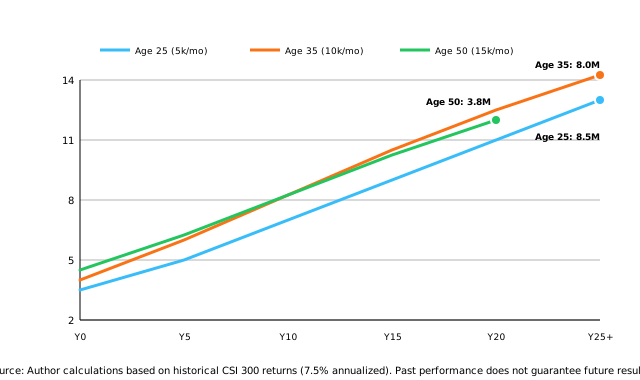
Important caveat: These projections assume consistent contributions, no major withdrawals, and average returns that smooth out the volatility experienced in practice. Real-world results will vary significantly—some years you'll be up 20%, others down 15%. The key is staying the course through the volatility.
The China-Specific Factors That Change Everything
Lifecycle theory was developed primarily in the U.S. context, but applying it in China requires adjusting for several structural differences:
Weaker Social Safety Net
China's Social Security replacement rate (the percentage of pre-retirement income replaced by state pensions) is approximately 40-45% for urban workers, compared to 50-60% in the U.S. (CASS, MOHRSS, 2024). For rural workers, it's even lower—approximately 15-20%. This means Chinese households need to save significantly more personally to maintain their standard of living in retirement.
The Hukou Divide
China's household registration (户口) system creates a two-tier pension system. Urban employees in formal sectors participate in the urban employee pension with employer contributions. Rural workers and informal urban workers rely on the resident pension, which provides minimal benefits—often less than 200 RMB/month. If you're a migrant worker with rural hukou working in a city, your retirement planning needs to account for potentially lower state pension benefits.
Healthcare Cost Inflation
While China has expanded health insurance coverage, out-of-pocket medical expenses remain significant—especially for serious illnesses. Healthcare costs have been growing at 8-10% annually in China, far outpacing general inflation. A major illness in retirement can consume years of savings without adequate insurance coverage.
Real Estate Over-Concentration
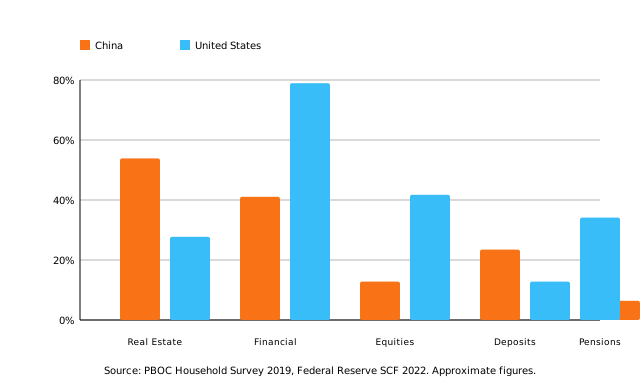
Chinese households hold approximately 60-65% of their wealth in real estate, compared to about 25-28% in the U.S. (PBOC Household Asset Survey 2019, Federal Reserve SCF 2022). This creates several risks:
- Illiquidity: Property can't be quickly converted to cash for emergencies
- Concentration risk: A housing market downturn devastates household balance sheets
- Leverage: Most property is mortgaged, amplifying losses in downturns
- Demographic headwinds: China's declining population suggests long-term housing demand weakness
Lifecycle theory suggests gradually reducing real estate concentration as you approach retirement—either through paying down the mortgage, selling investment properties, or supplementing with financial assets.
Capital Controls
China's capital controls limit offshore diversification. While QDII quotas have expanded, most Chinese investors have limited exposure to global markets. This means your portfolio is more exposed to China-specific risks (regulatory changes, geopolitical tensions, economic transition) than a globally diversified portfolio would be.
Tax-Advantaged Accounts
The 个人养老金账户 (Individual Pension Account), launched in 2022, offers a valuable tool: contributions up to 12,000 RMB/year are tax-deductible. For someone in the 20% tax bracket, that's up to 2,400 RMB in annual tax savings. The account can hold target-date funds, index funds, bank deposits, and insurance products—making it ideal for lifecycle investing.
Common Mistakes Chinese Retail Investors Make
Understanding what not to do is as important as knowing what to do. Here are the most common and costly mistakes observed among Chinese retail investors:
Mistake 1: Treating the Stock Market as a Casino
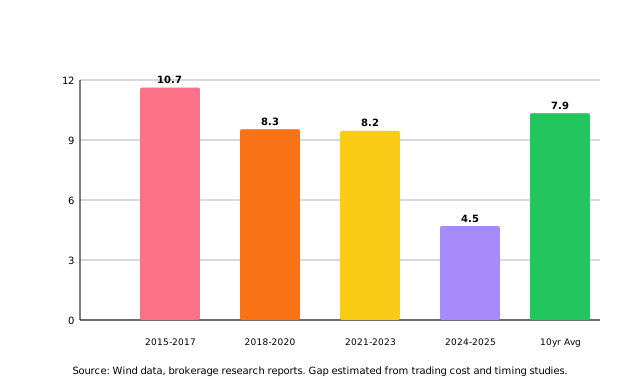
Chinese retail investors account for approximately 80% of A-share trading volume—compared to about 10-15% in the U.S. (Bloomberg, CFA Institute, 2024). With over 220 million retail investment accounts, this retail-heavy market encourages short-term trading, chasing hot stocks, and speculation. Studies consistently show that frequent traders underperform buy-and-hold investors by 3-5% annually after costs (Wind, brokerage research, 2024).
Mistake 2: No Emergency Fund
Many investors put every available yuan into stocks or real estate, leaving no liquid buffer. When emergencies arise—job loss, medical expenses, family needs—they're forced to sell assets at the worst possible time. The NBER study found that following AI advice would lead virtually all individuals to build savings buffers above $10,000 by age 30.
Mistake 3: Ignoring Insurance
A single major illness can wipe out decades of savings. Yet many Chinese investors view insurance as a waste of money rather than a critical component of lifecycle planning. 重疾险 and 医疗risks are not optional—they're the foundation that protects everything else you build.
Mistake 4: Chasing High-Yield "Wealth Management Products"
Bank wealth management products (理财产品) promising 4-5% returns with "guaranteed" principal have historically attracted massive inflows. But since the 2018 asset management reforms, these products are marked-to-market and can lose principal. Many investors still treat them as risk-free deposits.
Mistake 5: No Retirement Planning Until It's Too Late
Compound interest is most powerful over long time horizons. A person who starts investing at 25 needs to save roughly half as much per month as someone starting at 35 to reach the same retirement goal—assuming the same returns. Yet many Chinese workers don't seriously consider retirement until their 40s or 50s.
Mistake 6: Over-Concentration in Real Estate
With 70% of household wealth in property, many Chinese families are dangerously exposed to a single asset class. While real estate has been an excellent investment for the past two decades, demographic trends (declining population, urbanization slowdown) suggest more modest returns going forward.
Mistake 7: Following Insider Tips and Market Maker Rumors
The Chinese stock market has a cultural obsession with 庄家 (market makers/capital manipulators) and 内幕消息 (insider information). Retail investors frequently make decisions based on WeChat group tips, social media influencers, or "secret strategies"—almost all of which underperform simple index investing over time.
How to Use AI as Your Personal Financial Advisor (Practical Guide)
The NBER study's finding that prompt quality determines advice quality suggests a practical framework for getting the most out of AI financial planning. Here's how to write prompts that generate genuinely useful advice:
The Complete State Vector
Include these elements in your financial planning prompt:
- Demographics: Age, location (city affects cost of living), family status
- Income: Pre-tax annual income, income stability, expected career trajectory
- Assets: Breakdown by category (cash, stocks, funds, real estate, insurance cash value)
- Debt: Mortgage balance and rate, other loans, credit card debt
- Expenses: Monthly spending, major upcoming expenses (children's education, housing)
- Retirement: Target retirement age, expected pension income, desired retirement lifestyle
- Risk tolerance: How much portfolio decline you can handle without panic-selling
- Tax situation: Current tax bracket, available tax-advantaged accounts
Example Prompts by Life Stage
For a young professional (age 26):
"I am 26, single, working in Shenzhen earning 300,000 RMB/year after tax. I have 80,000 RMB in savings (all in Yu'e Bao), no debt, rent of 4,000 RMB/month. My employer offers a 6% pension match. I want to buy an apartment in 3-5 years (target price 2-3M RMB) and retire at 60. I can handle a 25% portfolio decline. How should I allocate my monthly savings of 10,000 RMB?"
For a mid-career parent (age 38):
"I am 38, married with one child (age 3), earning 500,000 RMB/year after tax. My wife earns 200,000 RMB. We have a home with 1.2M RMB remaining mortgage at 4.1% (20 years left), 300,000 RMB in CSI 300 ETF, 100,000 RMB in bonds, 200,000 RMB in cash. We spend 25,000 RMB/month. We want to save for our child's education (estimate 500,000 RMB needed in 15 years) and retire at 58 with 70% income replacement. How should we allocate our monthly savings of 20,000 RMB?"
For pre-retirement (age 55):
"I am 55, planning to retire at 60. I have 2M RMB in financial assets (60% stocks, 30% bonds, 10% cash), a paid-off apartment worth 3M RMB, and expect to receive 8,000 RMB/month from Social Security. I want to spend 15,000 RMB/month in retirement and leave some inheritance. I can handle a 15% portfolio decline. How should I restructure my portfolio for the next 5 years and develop a withdrawal strategy?"

AI Limitations to Keep in Mind
- No real-time data: AI doesn't know current interest rates, fund prices, or policy changes unless you provide them
- No tax optimization: AI may not be aware of China's specific tax rules for different account types
- No product availability: AI may recommend products not available in China
- No emotional support: AI can't talk you through a market crash or prevent panic-selling
- Stochasticity: The same prompt may produce different advice on different queries
The bottom line: Use AI as a thinking partner and starting point, not as a replacement for your own judgment or, when needed, a professional financial advisor who understands China's specific regulatory and product landscape.
What This Means for Chinese Retail Investors
The convergence of the NBER research and lifecycle theory sends a clear message to Chinese investors: the "exciting" approach to investing (stock picking, market timing, chasing hot sectors) is not just suboptimal for retirement planning—it's actively dangerous.
China's A-share market is particularly challenging for retail investors. It's characterized by:
- High volatility: CSI 300 annual volatility of 25-30% versus 15-18% for the S&P 500
- Retail dominance: Approximately 80% of trading volume comes from individual investors, compared to just 10-15% in the U.S. (Bloomberg, CFA Institute, 2024). China has over 220 million retail investment accounts.
- Policy sensitivity: Regulatory changes can dramatically impact sectors overnight
- Concentration risk: Many retail investors hold just 1-3 stocks, often in the same sector
- Chronic underperformance: Studies consistently show Chinese retail investors underperform the CSI 300 by 2-5% annually due to excessive trading, behavioral biases, and poor market timing (Wind, brokerage research, 2024)
In this environment, the lifecycle approach—broad diversification across asset classes, age-appropriate risk levels, and systematic rebalancing—isn't just theoretically optimal. It's practically necessary for survival.
The good news is that the tools for lifecycle investing in China have never been better:
- Low-cost index funds and ETFs are widely available
- The 个人养老金账户 provides tax-advantaged retirement savings
- 公募REITs offer real estate exposure without property management burden
- Online platforms make diversified investing accessible with small amounts
- AI can help you create and maintain a lifecycle plan—if you provide the right information
The NBER study found that following AI advice would move most people toward lifecycle theory's core prescriptions: broader participation in diversified equities, equity shares that decline with age, and meaningful savings buffers. For Chinese investors—who face unique challenges including over-concentration in real estate, weaker social safety nets, and higher healthcare costs—these principles aren't just academic theory. They're a practical roadmap to a secure retirement.
Frequently Asked Questions
Is lifecycle theory still relevant for Chinese investors?
More relevant than ever. China's unique challenges—over-concentration in real estate, weaker social safety nets, higher healthcare costs, and demographic headwinds—make lifecycle planning even more critical than in the U.S. The core principles (diversification, age-appropriate risk, emergency buffers) apply universally, though the specific products and allocations need adaptation for the Chinese market.
How do I apply these principles with A-shares and Chinese mutual funds?
The key building blocks are available: 沪深300ETF and 中证500ETF for domestic equity exposure, bond funds for fixed income, 黄金ETF for diversification, and 公募REITs for real estate exposure. For global diversification, QDII funds provide access to U.S. markets (S&P 500, NASDAQ 100). The 个人养老金账户 offers tax-advantaged wrappers for these investments.
What's the biggest mistake Chinese retail investors make?
Over-concentration—in individual stocks, in real estate, or in a single sector. The typical Chinese household has 70% of wealth in property and much of the remainder in just a few stocks. This concentration risk is the single biggest threat to retirement security. Diversification across asset classes, geographies, and time (through consistent investing) is the antidote.
Should I still pick individual stocks?
If you have genuine edge—information advantage, analytical capability, or structural access—individual stock investing can be part of a portfolio. But for retirement savings, individual stock picking should be a small allocation (10-20% at most) within a diversified lifecycle framework. The core of your retirement portfolio should be broad market exposure through low-cost index funds.
How much should I save for retirement in China?
A common guideline is 15-20% of gross income, including any employer pension contributions. Given China's lower Social Security replacement rate, aiming for the higher end of this range (20%+) is prudent. If you're starting late (after age 35), you may need to save 25-30% to catch up. Use the 个人养老金账户's 12,000 RMB/year tax deduction as a starting point, not a ceiling.
What about real estate as part of my portfolio?
Real estate is likely already your largest asset. Rather than viewing it as an "investment" to be optimized, treat it primarily as consumption (the home you live in). If you own additional properties, consider whether the returns justify the illiquidity, concentration risk, and management burden—especially as China's demographic outlook suggests more modest price appreciation going forward. 公募REITs offer real estate exposure with daily liquidity and lower minimum investment.
How do I handle the 个人养老金账户?
Open one at any participating bank or brokerage platform. Contribute up to 12,000 RMB/year for the tax deduction. Choose investments based on your age: target-date funds (目标日期基金) are the simplest option and automatically adjust allocation as you approach retirement. Alternatively, build your own allocation with the index funds and bonds available within the account.
What's the best age to start investing?
Yesterday. The second-best time is today. A person who starts investing ¥2,000/month at age 25 will have significantly more at age 60 than someone who starts investing ¥4,000/month at age 35—even though the second person contributes twice as much monthly. This is the power of compounding over time, and it's the single strongest argument for starting early, even with small amounts.
Conclusion
The NBER study's central finding is both simple and profound: when you ask AI for financial advice, it pushes you toward lifecycle theory—and lifecycle theory, despite its "boring" reputation, represents decades of research on how ordinary people can optimize their lifetime financial outcomes.
For Chinese retail investors, this message is especially important. The cultural obsession with stock picking, market timing, and chasing hot sectors is not just suboptimal—it's a form of gambling with your retirement security. The real goal of investing isn't to find the next 10-bagger. It's to ensure that the money you earn today can be safely, efficiently transferred to fund your consumption decades from now.
The lifecycle framework gives you a concrete, age-based roadmap:
- In your 20s: Build your emergency fund, start investing consistently, take appropriate risk
- In your 30s-40s: Maximize accumulation, diversify across asset classes, increase insurance
- In your 50s: Reduce risk, pay down debt, finalize your retirement plan
- In your 60s+: Shift to preservation and sustainable withdrawal
The tools are available. The knowledge is accessible. And AI can help you implement the plan—if you provide it with the right information.
Next time you're tempted to ask "which stock should I buy?", try asking instead: "Given my age, income, and goals, how should I allocate my portfolio for the next decade?" The answer might be less exciting. But it will almost certainly lead to a better retirement.
Sources
- Choukhmane, T., de Silva, T., Lin, W., & Akuzawa, M. (2026). "AI Financial Advice: Supply, Demand, and Life Cycle Implications." NBER Working Paper 35574. http://www.nber.org/papers/w35574
- Gourinchas, P.-O., & Parker, J. A. (2002). "Consumption over the Life Cycle." Econometrica, 70(1), 47-89.
- Cocco, J. F., Gomes, F. J., & Maenhout, P. J. (2005). "Consumption and Portfolio Choice over the Life Cycle." Review of Financial Studies, 18(3), 491-533.
- Bengen, W. P. (1994). "Determining Withdrawal Rates Using Historical Data." Journal of Financial Planning, 7(4), 171-180.
- Calvet, L. E., Campbell, J. Y., & Sodini, P. (2009). "Fight or Flight? Portfolio Rebalancing by Individual Investors." Quarterly Journal of Economics, 124(1), 301-348.
- People's Bank of China (PBOC). (2025). China Financial Stability Report.
- China Securities Regulatory Commission (CSRC). (2025). Annual Report.
- National Bureau of Statistics (NBS). (2025). China Statistical Yearbook.
- Lloyds Banking Group. (2025). "Over 28 million adults now using AI tools to help manage their money." Press Release.
- J.D. Power. (2025). "As more U.S. consumers struggle with rising prices, many turn to artificial intelligence for financial advice." Press Release.