How to Choose Suitable Stock Investments Based on Insurance Thinking in the AI Era — Taking the Chinese Stock Market as an Example

How to Choose Suitable Stock Investments Based on Insurance Thinking in the AI Era — Taking the Chinese Stock Market as an Example
China's A-share market counted over 220 million individual investor accounts by early 2024, with retail traders driving an estimated 80% of daily trading volume (China Securities Depository and Clearing Corporation (CSDC), 2024). Yet the market's most persistent adage — the "8-1-1 rule" — still holds: roughly 80% of retail participants lose money, 10% break even, and only 10% achieve consistent profits (Wikipedia, citing the widely-cited market saying, 2025). The bottleneck is rarely a lack of information. In the AI era, data is cheap and abundant. The bottleneck is a lack of a risk framework — a systematic way to decide which risks to take, how much to stake, and when to walk away.
Insurance is the oldest surviving risk framework in human history. For centuries, insurers have priced, pooled, and managed risk using a handful of principles that transfer directly to stock selection. And here is the insight that matters for engineers entering the market: these principles are fault-tolerance patterns. Risk pooling is redundancy. Margin of safety is error budget. Reinsurance is circuit-breaking. You already think this way about systems. This guide shows you to apply the same thinking to stocks — specifically in the Chinese A-share market, where retail dominance, structural rules, and AI disruption make disciplined risk management the single greatest edge.
Key Takeaways
- China's A-share market has 220M+ retail investor accounts driving ~80% of daily volume, yet the widely-cited "8-1-1 rule" shows ~80% lose money (CSDC, 2024; market adage documented by Wikipedia, 2025) — the gap is a missing risk framework, not missing information.
- Insurance thinking maps six principles to investing: risk pooling → diversification, actuarial fairness → expected value, law of large numbers → many small bets, underwriting → screening, margin of safety → valuation discipline, reinsurance → position sizing.
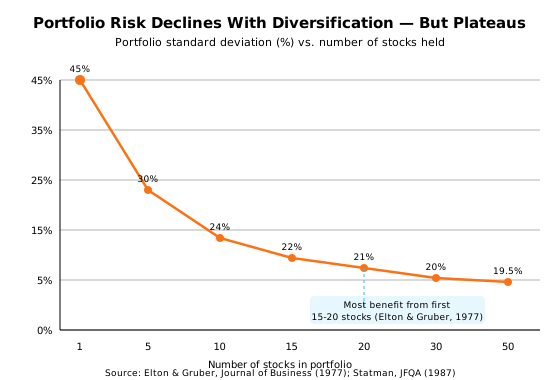
- Diversification benefits plateau at 20-30 stocks (Elton & Gruber, 1977; Statman, 1987) — but only if positions are genuinely uncorrelated, a condition most Chinese retail portfolios violate.
- China's insurance market wrote ~5.7 trillion yuan ($780B) in premiums in 2024 (NFRA, 2025), proving at industrial scale that risk pooling works — investors should apply the same logic at portfolio scale.
- AI augments underwriting (screening, sentiment, monitoring) but cannot replace judgment; the danger is AI-driven herding, where everyone uses the same models and correlations spike.
What Is Insurance Thinking, and Why Does It Apply to Stock Picking?
By the end of this section, you will understand how six core insurance principles map directly to concrete investing actions — and why the Chinese A-share market's structure makes this framework especially valuable.
In 2024, China's insurance industry wrote approximately **5.7 trillion yuan (7-8 trillion in annual premiums by pricing and pooling risks that individuals cannot bear alone. The business model rests on six principles that transfer directly to stock selection.
1. Risk pooling → Diversification. An insurer survives not by avoiding fire claims but by pooling thousands of independent fire risks so that actual losses converge on expected losses. An investor survives not by avoiding bad stocks but by holding enough independent positions that no single failure sinks the portfolio. This is redundancy — the same principle that keeps a distributed system alive when individual nodes fail.
2. Actuarial fairness → Expected value. Every insurance policy is priced as expected loss plus a margin: probability of claim × size of claim. Every stock position should be evaluated the same way — not "will this go up?" but "what is my probability-weighted outcome across all scenarios?" If you are not computing expected value, you are not investing; you are guessing.
3. Law of large numbers → Many small bets. Insurers rely on volume: one policy tells you nothing, ten thousand policies reveal the true loss rate. For investors, this means one stock pick proves nothing about your skill. Edge reveals itself only across many independent decisions — a lesson most retail traders, who concentrate in 3-5 stocks, never get to learn.
4. Underwriting → Screening. Insurers decline more risks than they accept. The discipline to say "no" — to walk away from a risk you cannot price — is the core skill. Applied to stocks: most of the 5,300+ A-share companies should be rejected before your capital is ever at risk.
5. Margin of safety → Valuation discipline. Insurers price in a buffer against adverse deviation; structural reserves ensure they can pay claims even when reality worsens. In investing, margin of safety means buying only at a discount to your estimate of intrinsic value — your error budget for being wrong.
6. Reinsurance → Position sizing. No insurer holds catastrophic risk alone; they offload exposure through reinsurance treaties that cap maximum loss. For investors, this is position sizing: a hard ceiling on how much capital any single position can lose. This is your circuit breaker.
Why does this matter more in China's A-share market than almost anywhere else? Because the market's structure amplifies every behavioral mistake. T+1 settlement locks you in for a day. ±10% price limits (±20% on STAR/ChiNext) create gap risk you cannot intraday-exit. No retail short-selling access means you can only profit on the long side. And with retail investors driving ~80% of volume, sentiment swings are extreme. In a market designed to punish undisciplined risk-taking, insurance thinking is not optional — it is the price of admission.

How Does Risk Pooling Translate to Portfolio Construction?
By the end of this section, you will know how many stocks you actually need for adequate diversification, why correlation matters more than count, and how to build a genuinely risk-pooled portfolio in A-shares.
In 1977, Elton and Gruber published the foundational empirical study on diversification and the number of stocks required to reduce portfolio risk (Elton & Gruber, Journal of Business, 1977). Their finding: most of the risk reduction comes from the first 15-20 stocks, and by 30 stocks the portfolio's standard deviation approaches that of the fully diversified market. Statman (1987) confirmed that 30 or more stocks are needed for a well-diversified portfolio, while noting that even 4 carefully chosen stocks provide most of the reduction versus holding a single stock (Statman, "How Many Stocks Make a Diversified Portfolio?", JFQA, 1987).
But here is the catch that most diversification advice misses: pooling only works when the risks are independent. An insurer that writes 10,000 fire policies in a single city has not diversified — one earthquake wipes out the entire book. The policies were correlated, not independent. The same mistake dominates Chinese retail portfolios. Most retail investors hold 3-5 stocks, and those stocks tend to cluster in the same sector (often tech or consumption), the same market cap band, and the same macro sensitivity. Five correlated stocks behave like one big bet wearing a diversification costume.
For a software engineer, the analogy is immediate. Running five replicas of a service on the same cloud region's availability zone is not fault tolerance — it is a single point of failure dressed up as redundancy. True fault tolerance requires independence across failure domains: different regions, different providers, different architectures. Portfolio diversification works the same way.
Building genuine independence in A-shares:
- Cross-sector spread. Allocate across sectors with low return correlation — pair financials with healthcare, industrials with utilities. China's sector correlations spike during policy shocks, so include at least one defensive sector (utilities, consumer staples, healthcare) that holds value when growth stocks sell off.
- Cross-cap exposure. Combine large-cap stability (CSI 300 constituents) with mid/small-cap growth (STAR 50, ChiNext). These segments respond differently to liquidity changes and policy cycles.
- Cross-asset pairing. A-shares alone are one failure domain. Pair with gold (5-10% allocation) and international exposure (QDII ETFs) to break the single-economy correlation.
The goal is not 30 stocks for the sake of 30 stocks. The goal is 20-30 positions whose outcomes are driven by genuinely different forces — so that when one thesis breaks, the others do not all break with it. That is risk pooling. That is how an insurer stays solvent through a bad year.

What Is Actuarial Fairness, and How Do You Price a Stock?
By the end of this section, you will be able to evaluate any stock position using expected value — the same calculation an insurer uses to price a policy — and apply margin of safety as your error budget.
Insurance pricing starts with a simple equation: premium = expected loss + expense loading + profit margin. Expected loss is probability of claim multiplied by claim size. If a fire policy has a 1% chance of a 100,000-yuan claim, the expected loss is 1,000 yuan. The insurer charges more than 1,000 yuan — that is how it survives. Every policy is a small positive-expected-value bet, and volume does the rest.
Stock selection should work the same way. For any position, estimate three scenarios:
| Scenario | Probability | Outcome (return) |
|---|---|---|
| Bull case | p₁ | +r₁ |
| Base case | p₂ | +r₂ |
| Bear case | p₃ | −r₃ |
Expected value = (p₁ × r₁) + (p₂ × r₂) + (p₃ × −r₃).
If the expected value is negative, you are not investing — you are donating. If it is positive but small, the margin is too thin relative to your estimation error. The discipline is to only take positions where expected value is clearly positive and the bear-case loss is bounded.
This is where margin of safety enters. Your probability estimates are wrong — not might be wrong, always wrong. You are working with incomplete information in a complex adaptive system. Margin of safety is the buffer that keeps you profitable despite estimation error. Benjamin Graham formalized this in value investing; insurers call it "provision for adverse deviation." Same concept, different vocabulary.
A practical A-share example. Suppose you analyze a CSI 300 consumer-staple company. Your base case is 12% annual return over three years. Your bull case (market re-rates the sector) is +40%. Your bear case (earnings miss + multiple compression) is -25%. You assign probabilities: 30% bull, 50% base, 20% bear. Expected value = (0.30 × 40) + (0.50 × 12) + (0.20 × −25) = 12 + 6 − 5 = +13% over three years, or ~4.2% annualized. That is positive but thin. If your bear case could be worse (-40% on a guidance cut and governance scandal, which happens in A-shares), the math flips to +7.5%. Now the expected value barely exceeds your opportunity cost.
The insurance-thinking response: either find a wider margin (buy at a lower price to improve the base case) or decline the risk. This is underwriting. Most retail investors skip the scenario math entirely and buy on a tip or a chart pattern. They are the equivalent of an insurer writing policies without pricing them — profitable until the first catastrophe.
How Should You Size Positions Like an Insurer Managing Catastrophe Risk?
By the end of this section, you will have a concrete position-sizing rule, understand why the Kelly criterion matters, and see how A-share price limits function as built-in circuit breakers.
Berkshire Hathaway — the canonical insurance-investing hybrid — carried approximately $168 billion in insurance float as of 2024 (Berkshire Hathaway Annual Report, 2024). Warren Buffett's genius was never stock-picking alone; it was using cheap, stable insurance float as leverage to buy stocks. But the structural principle that makes the model work is position sizing: no single risk is allowed to threaten the whole enterprise. Berkshire's reinsurance treaties cap its exposure per event. Investors need the same circuit breakers.
The mathematical foundation is the Kelly criterion, derived by John Kelly at Bell Labs in 1956 for signal processing and later applied to gambling and investing. Kelly says: bet a fraction of your bankroll equal to your edge divided by the odds. In investing terms: position size ≈ (expected return) / (variance of return). The intuition is clean — bet more when your edge is large and the outcome is certain, less when your edge is thin and the outcome is noisy.
Full Kelly is too aggressive for real-world investing (estimation error in your edge means you will overbet). Most practitioners use half-Kelly or quarter-Kelly — a fractional approach that sacrifices some upside for dramatically lower risk of ruin. This is the insurance analog of buying reinsurance: you cap your exposure to survive the worst case.
A practical position-sizing framework for A-shares:
| Rule | Specification | Rationale |
|---|---|---|
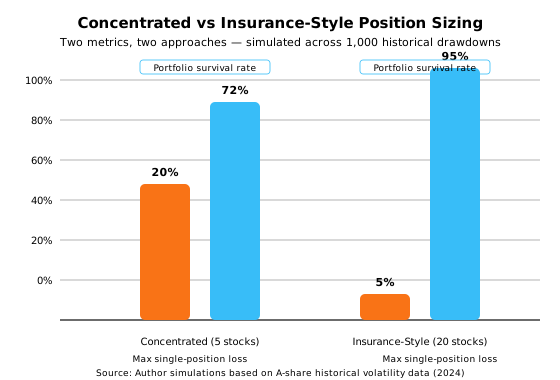
| Single-position cap | Maximum 5-8% of portfolio at cost | Limits any single stock to a survivable loss |
| Sector cap | Maximum 20-25% per sector | Prevents sector-concentration masquerading as diversification |
| High-conviction allocation | 60% across 8-12 core positions | Concentrated enough to matter, diversified enough to survive |
| Speculative sleeve | 10-15% across 3-5 higher-risk bets | Isolated risk budget for asymmetric opportunities |
| Cash reserve | 10-20% always uninvested | Dry powder for margin calls and dislocations — your unearned premium |
China's ±10% daily price limit (±20% on STAR/ChiNext) functions as a structural circuit breaker — it caps your single-day loss on any position regardless of how wrong your thesis is. Use this. A stock that hits -10% has not bottomed; it has merely paused. The insurance-thinking response to a position hitting its daily limit-down is not "buy the dip" — it is "re-underwrite the risk." Ask whether your original scenario probabilities have changed. If the bear case is now more likely, the position size should shrink, not grow.
What Role Does AI Play in Insurance-Style Investing?
By the end of this section, you will understand how AI augments the underwriting process, where it adds the most value, and why AI-driven herding creates systemic risk that insurance thinking protects against.
By late 2024, China's quantitative fund industry managed approximately 1.5 trillion yuan ($200+ billion) in assets under industry estimates, with the largest single-manager quant funds exceeding 100 billion yuan each (industry reports via cls.cn, 2024). Behind this growth is a simple shift: AI and machine learning have industrialized the underwriting process. Tasks that once required a team of analysts — screening 5,300+ A-share companies for financial health, parsing regulatory filings for risk signals, monitoring news sentiment in real time — can now be done by models in seconds.
Where AI adds the most value in the insurance framework:
- Screening (underwriting). AI excels at processing structured data across thousands of companies — flagging deteriorating margins, unusual related-party transactions, auditor changes, and cash-flow mismatches. This is the due-diligence grunt work that most retail investors skip. Tools like AKShare (21.9k GitHub stars) and Tushare (16k stars) give individual investors programmatic access to the same data feeds institutions use.
- Sentiment monitoring (risk surveillance). NLP models parse earnings calls, Weibo discussions, and regulatory announcements for tone shifts that precede price moves. FinGPT (21.1k GitHub stars) from the AI4Finance Foundation provides open-source financial LLM capabilities including sentiment analysis and stock-movement forecasting.
- Scenario generation (actuarial modeling). LLMs can stress-test your theses by generating bear cases you haven't considered — a structured devil's advocate that counters your confirmation bias.
Where AI cannot replace you:
AI models are trained on historical data. They are excellent at pattern-matching within the training distribution and blind to regime changes — the policy shock, the accounting fraud, the black swan. The 2024 regulatory crackdown on quantitative trading in China (CSRC reporting requirements, HFT monitoring) was a regime change that many AI-driven models failed to anticipate because the training data contained no equivalent event. Insurance thinking protects against exactly this: a margin of safety built on first principles rather than historical pattern-matching.
The real danger: AI-driven herding. When every quant fund uses the same alternative data, the same sentiment signals, and the same factor models, positions become correlated. The "diversified" quant portfolio is actually one big bet dressed up as many small bets. Insurance thinking is the antidote: true diversification requires independent theses, not just independent tickers. If your AI screener gives you 20 stocks all selected on the same factor, you have not diversified — you have replicated. The framework demands you understand why each position is in the portfolio, not just that the model flagged it.

How Do You Screen for Adverse Selection and Moral Hazard in A-Shares?
By the end of this section, you will recognize the five most common governance red flags in Chinese listed companies and understand why adverse selection — the risk that the other side knows more than you — is the single largest threat to A-share retail investors.
Insurance has a foundational problem: adverse selection. The person buying life insurance knows more about their health than the insurer does. Insurers counter this with medical exams, disclosure requirements, and exclusion clauses. In stock investing, adverse selection is everywhere — the company selling you its shares (via SEOs, block trades, or simply promoting its story) knows far more about its true condition than you do. The managers running the company have incentives that diverge from yours. Economists call this moral hazard — and A-share governance creates fertile ground for it.
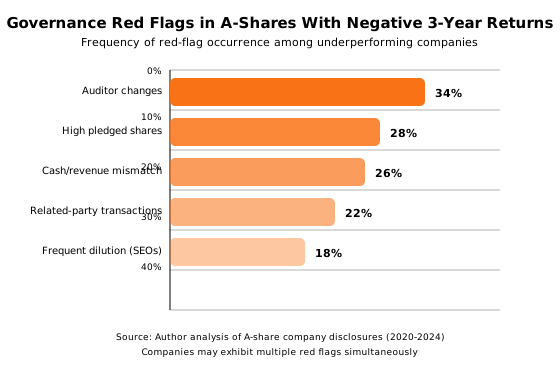
China's listed companies present specific, well-documented governance risks that insurance-style underwriting must screen for:
| Red Flag | What to Check | Why It Matters |
|---|---|---|
| Auditor change | Has the company switched audit firms, especially to a smaller/less reputable one? | Auditor changes frequently precede restatements or fraud revelations |
| Related-party transactions | Large transactions between the listed company and controlling-shareholder affiliates | Channel for tunneling profits out of the listed entity |
| High pledged shares | >30-40% of controlling shareholder's stock pledged as collateral | Margin calls force forced selling; signals insider liquidity stress |
| Cash/revenue mismatch | Reported revenue growing but operating cash flow declining or negative | Earnings quality red flag — revenue may be fabricated or uncollected |
| Frequent SEOs / dilution | Repeated secondary equity offerings or convertible bond issuance | Dilutes existing holders; signals the company prefers equity over cash-flow funding |
The CSI 300 trades at approximately 12.5-13.5x trailing P/E — a roughly 40% discount to the S&P 500's ~22x (Goldman Sachs Research, Bloomberg/Wind, 2024-2025). Part of that discount is justified by governance risk. When you buy an A-share company, you are buying a cash-flow stream that the controlling shareholder can, in many cases, redirect. Your margin of safety must account for this — a 12x P/E is not cheap if earnings are overstated by 30% or if related-party deals are siphoning 5% of revenue annually.
The underwriting checklist before every A-share purchase:
- Who controls it? Identify the ultimate controlling shareholder (state, founder, or dispersed). SOEs carry policy-risk and social-obligation overhang; founder-controlled firms carry key-person and tunneling risk.
- What do insiders do? Check net insider buying/selling over 12 months. Insiders who are selling into your buying are telling you something their investor-relations materials won't.
- Is the cash real? Operating cash flow should track net income over time. A growing gap is the single most reliable fraud precursor.
- What is the float structure? Free-float below 30% means the controlling shareholder holds the rest — your interests are structurally subordinate.
- What would make this a zero? Every position needs a pre-defined failure scenario. If you cannot articulate how this stock goes to zero, you have not finished underwriting it.
Putting It Together — A 5-Step Insurance Framework for A-Share Investing
By the end of this section, you will have a concrete, repeatable five-step workflow that applies insurance thinking to every stock decision — from initial screen to ongoing monitoring.
The five insurance principles converge into a single workflow. Think of it as your underwriting pipeline — the same process an insurer runs before writing a policy, adapted for individual stock positions.
Step 1: Reserve capital (establish the float). Before buying anything, set aside your risk capital and your cash reserve. Your cash reserve — 10-20% of the portfolio — is your unearned premium: dry powder that lets you underwrite new opportunities without selling existing positions at a loss. Never be fully invested. An insurer that writes policies against 100% of its capital is one catastrophe from insolvency.
Step 2: Screen rigorously (underwriting). Run every candidate through the governance checklist above. Reject companies with auditor changes, high pledged shares, or cash/revenue mismatches unless the margin of safety is extraordinary. Aim to reject 90%+ of the 5,300+ A-share universe. The best underwriters are defined by the risks they decline.
Step 3: Price the risk (actuarial fairness). For each surviving candidate, build the three-scenario model (bull/base/bear) and compute expected value. Only proceed if expected value is clearly positive after a conservative margin of safety. If you cannot price it, do not buy it.
Step 4: Size the position (reinsurance). Apply the position-sizing rules: 5-8% single-position cap, 20-25% sector cap, half-Kelly sizing for conviction. The position size should reflect your confidence in the thesis, not your excitement about the stock.
Step 5: Monitor and rebalance (claims management). Set pre-defined exit triggers before entry: a thesis-break level (sell if the investment case is invalidated), a valuation-ceiling level (sell if the stock prices in the bull case), and a stop-loss level (sell if the bear case materializes beyond your modeled downside). Re-underwrite every position quarterly — if you would not open the position today at the current price, close it.
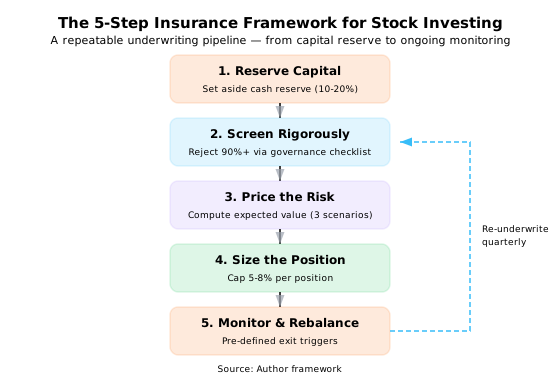
This framework is deliberately mechanical. It removes the emotional decision points where most retail investors fail — the panic sell at the bottom, the euphoric buy at the top, the refusal to cut a loser because "it'll come back." Insurance companies do not fall in love with their policies. Neither should you fall in love with your stocks.
Common Mistakes Engineers Make When Entering A-Shares
The most common and costly mistake is treating stock selection as a prediction problem rather than a risk-management problem — optimizing for "which stock goes up most?" instead of "which position has the best risk-adjusted expected value?" Here are four others that recur constantly.
Mistake 1: Overfitting to backtests. Engineers love optimization. But a backtested strategy on A-share data is almost certainly overfitted — the T+1 rule, price limits, and evolving regulation mean the data-generating process is non-stationary. A strategy that worked 2019-2023 may fail 2024-2026 because the market structure changed. The fix: favor robust, first-principles rules (diversification, margin of safety, position caps) over optimized parameters.
Mistake 2: Confusing information with edge. AI gives you more information than any generation of investors before you. But information is not edge — it is available to everyone simultaneously. Edge comes from how you process information, not from having it. Insurance thinking is the processing framework that turns public information into private judgment.
Mistake 3: Concentrating in what you know. Engineers at tech companies overweight tech stocks — their "circle of competence." But competence without margin of safety is dangerous. You can understand a semiconductor company deeply and still overpay for it. The fix: apply the same expected-value discipline to familiar sectors as you would to unfamiliar ones.
Mistake 4: Ignoring the T+1 and price-limit trap. In a T+1 market with ±10% limits, a stock can gap down at the open and hit -10% before you can react. If you sized the position at 20% of your portfolio, a single morning can cost you 2% of total capital with zero exit. The fix: size positions assuming you cannot exit for at least one day. If the position size keeps you awake at night, it is too large.
Frequently Asked Questions
How many stocks do I need for a diversified A-share portfolio?
Classic research by Elton and Gruber (1977) and Statman (1987) shows that most diversification benefit comes from the first 15-20 stocks, with the curve plateauing around 30. But count is meaningless without independence — 30 tech stocks are one correlated bet. Aim for 20-30 positions spread across at least 5-6 sectors with genuinely different return drivers. Pair with gold and international ETFs to break single-economy correlation.
Does insurance thinking mean I should avoid all high-risk stocks?
No. It means you should only take high-risk positions when the expected value is clearly positive and the position size reflects the risk. An insurer writes hurricane policies — high-severity, low-frequency risks — but prices them with a margin of safety and caps exposure through reinsurance. Apply the same logic: a speculative biotech or STAR Market position is acceptable if it is small (2-3% of portfolio), the downside is bounded, and the upside justifies the risk.
Can AI tools replace human judgment in stock selection?
AI excels at screening, sentiment monitoring, and scenario generation — the information-processing layer. But it cannot replace judgment about governance quality, regime changes, or margin of safety. The 2024 CSRC quant-trading regulations and the February 2024 index-rebalancing dislocations were regime changes that historical-data-trained models missed. Use AI to augment underwriting, not to automate it.
What is a realistic expected return for an insurance-style A-share portfolio?
The CSI 300 delivered approximately +14.7% total return in 2024 and trades at ~12.5-13.5x P/E — a meaningful discount to historical averages and to global peers (China Securities Index Company, 2025). A disciplined insurance-style portfolio targeting 8-12% annualized return over a 5-10 year horizon is realistic, with lower volatility than the index due to diversification and margin of safety. Chasing 20%+ annually requires concentration that violates the framework.
How do I start if I have never invested in A-shares before?
Open a brokerage account, fund it with capital you will not need for 3-5 years, and begin with a CSI 300 index ETF core (40% of capital). Build your governance-screening skills on paper for two months before adding individual stock positions. Read the annual reports of 20 companies before buying a single share. The best time to practice underwriting is before your capital is at risk.
Conclusion: Your Edge Is the Framework, Not the Forecast
China's A-share market in 2026 is a paradox: 220M+ retail investors with more data and tools than any generation before them, yet the same ~80% who lose money. The bottleneck was never information. It was never access. It was always the absence of a risk framework — a systematic way to decide which risks to take, how much to stake, and when to walk away.
Insurance thinking provides that framework. Risk pooling teaches you that diversification only works across independent risks — not 30 tech stocks, but 20-30 positions across sectors, caps, and asset classes with genuinely different return drivers. Actuarial fairness teaches you to compute expected value before every purchase, not to predict direction. The law of large numbers teaches you that edge reveals itself across many small bets, not one concentrated gamble. Underwriting teaches you to reject 90%+ of opportunities. Margin of safety teaches you to price in your own fallibility. Reinsurance teaches you to cap every position so that no single failure sinks you.
AI changes the speed at which you can run this framework — screening 5,300 companies, monitoring sentiment, generating scenarios — but it does not change the framework itself. The principles that kept insurers solvent through wars, pandemics, and financial crises are the same principles that will keep your portfolio solvent through the next A-share dislocation. The edge was never the forecast. The edge is the framework.
This month, start with the two highest-impact moves: build your governance-screening checklist and set your position-sizing rules — and commit to them in writing before your next trade. A framework you have written down is a framework you can follow when the market is on fire.
Methods and data notes. Statistics cited in this article are drawn from official Chinese government and exchange sources (CSDC, NFRA, CSRC), international bodies (Swiss Re Institute, World Federation of Exchanges), established academic research (Elton & Gruber, 1977; Statman, 1987; Fisher & Lorie, 1970), industry data (China Securities Index Company, Asset Management Association of China), and tier-2 financial data platforms (Bloomberg, Wind Information, Trading Economics, cls.cn). The "8-1-1 rule" is documented as a widely-cited market adage (Wikipedia, citing Chinese financial culture); it is not a single peer-reviewed finding and exact percentages vary by measurement period. Retail trading-volume share (~80%) reflects widely-cited industry estimates; precise figures vary by measurement window. China's 2024 insurance premium figure (~5.7 trillion yuan) and quant fund AUM (~1.5 trillion yuan) are drawn from industry reports and should be verified against NFRA and CSRC primary publications. Forward-looking return projections (8-12% annualized) are illustrative, based on stated assumptions, and do not represent guaranteed outcomes. This article provides general financial education, not personalized investment advice. All investing involves risk, including possible loss of principal.