Zero-Cost Handshake Between C and Lua: Anatomy of the FFI Subsystem
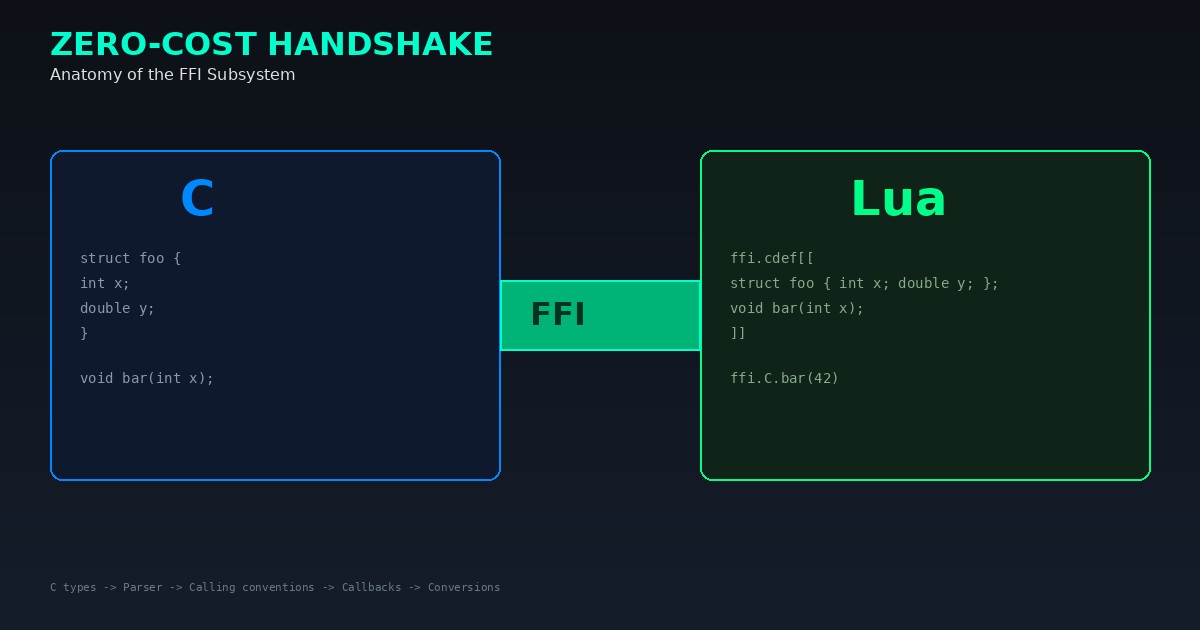
LuaJIT lets you call C functions, access C data structures, and implement callbacks — all without writing a single line of C glue code. The overhead? For simple calls, it's effectively zero. For complex types, the marshalling layer handles the complexity automatically.
This is the FFI (Foreign Function Interface) subsystem: a self-contained module that bridges Lua and C with remarkable efficiency. It's the finale of our deep-dive series into LuaJIT's internals, and it ties together everything we've learned — NaN-boxed values, the JIT compiler, DynASM, and the GC — into a cohesive whole.
In this article, you'll learn the FFI architecture, the C type system, the minimal parser, platform calling conventions, callback trampolines, type conversions, and the metamethod interface that makes it all accessible from Lua.
Key Takeaways
- The FFI is a self-contained subsystem: type system, parser, call handling, callbacks, conversions.
- C types are interned in a central table (
CTState), enabling fast type lookup and reuse.- Callbacks use dynamically generated machine code trampolines for near-zero overhead.
- The parser is minimal — not a validating C parser, just enough for FFI declarations.
- Type marshalling handles the complexity of C/Lua value conversion automatically.
Architecture Overview — A Self-Contained Subsystem
The FFI is implemented across nine source files, each handling a distinct responsibility:
 ┌─────────────────────────────────────────────────────────────────┐
 │                     FFI Subsystem Architecture                   │
 │                                                                 │
 │  lib_ffi.c        │ Lua-facing API (ffi.cdef, ffi.new, etc.)   │
 │  lj_ctype.c       │ C type system (CTState, CType, interning)  │
 │  lj_cparse.c      │ C declaration parser (minimal, for FFI)    │
 │  lj_ccall.c       │ C function calling (platform conventions)  │
 │  lj_ccallback.c   │ Lua→C callbacks (dynamic trampolines)      │
 │  lj_cconv.c       │ Type conversions (Lua ↔ C marshalling)     │
 │  lj_cdata.c       │ C data objects (GCcdata, variable-size)    │
 │  lj_clib.c        │ C library loading (dlopen, namespaces)     │
 │  lj_carith.c      │ C data arithmetic (cdata metamethods)      │
 └─────────────────────────────────────────────────────────────────┘
The flow: Lua code calls ffi.cdef("...") → parser builds type descriptors → types interned in CTState → ffi.C.func() calls C via lj_ccall.c → results converted via lj_cconv.c → returned as Lua values.
The C Type System — Interned Type Descriptors
At the core of the FFI is a type system that represents C types as interned descriptors.
The CTState Structure
typedef struct CTState {
  CType *tab;           /* C type table (dynamic array) */
  CTypeID top;          /* Current top */
  MSize sizetab;
  lua_State *L;
  global_State *g;
  GCtab *miscmap;       /* -CTypeID → metatable; cb slot → func */
  CCallback cb;         /* Temporary callback state */
  CTypeID1 hash[CTHASH_SIZE];  /* Hash anchors */
} CTState;
The type table is a dynamic array of CType descriptors. Types are interned — identical types share the same CTypeID, enabling fast equality comparison.
The CType Structure
typedef struct CType {
  CTInfo info;      /* Type info: type(4) + flags(20) + cid/attrib(16) */
  CTSize size;      /* Type size */
  CTypeID1 sib;     /* Sibling element */
  CTypeID1 next;    /* Hash chain next */
  GCRef name;       /* Element name (GCstr) */
} CType;
The info field is a packed bitfield:
- Bits 0-3: type number (VOID, STRUCT, PTR, ARRAY, etc.)
- Bits 4-23: flags (CONST, UNSIGNED, LONG, etc.)
- Bits 23-31: cid or attribute
Predefined Types
LuaJIT predefines common C types at startup:
- VOID, BOOL, INT8-UINT128, FLOAT, DOUBLE
- COMPLEX_FLOAT, COMPLEX_DOUBLE
- P_VOID, P_CCHAR (pointer types)
Type Interning
When a type is parsed, the FFI first checks if an identical type already exists. If so, it reuses the existing CTypeID. This is done via a hash table (CTState.hash):
CTypeID lj_ctype_intern(CTState *cts, CTInfo info, CTSize size) {
  /* Check if this type already exists */
  CTypeID id = find_type(cts, info, size);
  if (id) return id;  /* Reuse existing type */
  /* Create new type */
  return add_type(cts, info, size);
}
The C Declaration Parser — Minimal but Sufficient
The FFI parser is not a validating C compiler. It's a minimal parser designed specifically for FFI declarations.
Why Not Validate?
The FFI trusts the programmer. If you declare int foo(char *s) but the actual function takes int, that's your bug. The parser's job is to extract enough information to:
- Build type descriptors for the JIT
- Determine calling conventions
- Generate correct marshalling code
The CPState Structure
typedef struct CPState {
  CPChar c; CPToken tok; CPValue val; GCstr *str; CType *ct;
  const char *p; SBuf sb; lua_State *L; CTState *cts;
  TValue *param; const char *srcname; BCLine linenumber;
  int depth; uint32_t tmask; uint32_t mode;
  uint8_t packstack[CPARSE_MAX_PACKSTACK]; uint8_t curpack;
} CPState;
The parser has its own lexer (cp_number, cp_ident, cp_param) that tokenizes C declarations. It handles:
- Declaration specifiers (
int,const,unsigned,struct, etc.) - Declarators (pointer/array/function declarators)
- Abstract types (without names)
- Bitfields, enums, structs/unions
- Attributes (
__attribute__,__declspec)
Mode Flags
#define CPARSE_MODE_ABSTRACT   /* Parse abstract type (no name) */
#define CPARSE_MODE_DIRECT     /* Parse direct declaration */
#define CPARSE_MODE_FIELD      /* Parse struct field */
#define CPARSE_MODE_SKIP       /* Skip declaration (just count) */
Calling C Functions — Platform Conventions
Calling C from Lua requires understanding the platform's calling convention — which registers hold arguments, how structs are returned, etc.
The lj_ccall.c Structure
/* Platform-specific limits */
#if LJ_TARGET_X86
#define CCALL_MAX_GPR  2   /* eax, edx */
#define CCALL_MAX_FPR  0   /* no FP registers for args */
#elif LJ_TARGET_X64
#define CCALL_MAX_GPR  6   /* rdi, rsi, rdx, rcx, r8, r9 (SysV) */
#define CCALL_MAX_FPR  8   /* xmm0-7 */
/* Win64: 4 GPR, 4 FPR */
#elif LJ_TARGET_ARM64
#define CCALL_MAX_GPR  8   /* x0-x7 */
#define CCALL_MAX_FPR  8   /* d0-d7 */
#endif
The Call Path
ffi.C.func(args)→lj_ccall_func()inlib_ffi.c- Marshal Lua args to C registers/stack via
lj_cconv.c - Call the C function pointer
- Marshal C return value to Lua value via
lj_cconv.c
Struct Returns
Different platforms handle struct returns differently:
- x86-64 SysV: Structs ≤ 16 bytes returned in registers; larger structs via hidden pointer
- x86-64 Win64: Structs ≤ 8 bytes in register; larger via hidden pointer
- ARM64: Structs ≤ 16 bytes in registers; larger via hidden pointer
The FFI handles all these cases automatically.
C Data Objects — cdata
C data lives in GCcdata objects — Lua values that hold C data inline.
The GCcdata Structure
typedef struct GCcdata {
  GCHeader;
  CTypeID1 ctypeid;   /* Reference to the C type */
  /* Data follows here (variable size) */
} GCcdata;

/* Variable-size cdata (VLA, aligned) */
typedef struct GCcdataVar {
  CTypeID1 ctypeid;
  CTSize len;         /* Extra length */
  CTSize extra;       /* Prefix extra */
  /* Data follows */
} GCcdataVar;
The ctypeid links to the type descriptor in CTState, which tells the FFI how to interpret, convert, and garbage-collect the data.
Creating cdata
-- Create a C integer
local x = ffi.new("int", 42)        -- cdata holding int 42

-- Create a C struct
local s = ffi.new("struct { int x; double y; }", 1, 2.0)

-- Create a C pointer
local p = ffi.new("int[10]")        -- array of 10 ints
Callbacks — Dynamically Generated Trampololines
The most ingenious part of the FFI: callbacks that let C code call back into Lua functions, with near-zero overhead.
The Callback Page Pool
#define CALLBACK_MCODE_SIZE  (LJ_PAGESIZE * LJ_NUM_CBPAGE)
/* Default: 4096 * 256 = 1MB of executable memory */
A dedicated pool of executable memory pages holds dynamically-generated machine code. Each slot is a small trampoline:
Trampoline Generation (x86)
; Each callback slot:
mov al, slot_number    ; 2 bytes: B0 xx
jmp lj_vm_ffi_callback ; 5 bytes: E9 xx xx xx xx
; Total: 7 bytes per slot
The slot number is encoded directly in the instruction, then jumps to the common handler. The handler looks up the slot, retrieves the Lua function from cts->miscmap, converts C arguments to Lua values, calls the function, and converts the result back.
Trampoline Generation (ARM64)
; ARM64 trampoline:
mov x16, slot_number   ; Load slot number
b lj_vm_ffi_callback   ; Branch to handler
The CCallback Structure
typedef struct CCallback {
  FPRCBArg fpr[CCALL_MAX_FPR];  /* FPR args/results */
  intptr_t gpr[CCALL_MAX_GPR];  /* GPR args/results */
  intptr_t *stack;              /* Stack args */
  void *mcode;                  /* Machine code base */
  CTypeID1 *cbid;               /* Callback type table */
  MSize sizeid, topid, slot;
} CCallback;
Creating a Callback
-- Create a callback: C function pointer that calls a Lua function
local cb = ffi.callback("int(*)(int)", function(x)
  return x * 2
end)

-- Pass it to a C function
ffi.C.qsort(array, n, ffi.sizeof("int"), cb)
The ffi.callback() function:
- Allocates a slot in the callback page pool
- Returns a function pointer to the trampoline for that slot
- Stores the Lua function in
cts->miscmap[slot]
When C calls the callback, the trampoline dispatches to lj_vm_ffi_callback, which does the full Lua/C transition.
 C code calls callback          Trampoline              Common handler
 ──────────────────────▶  mov al, slot ───────▶  lj_vm_ffi_callback
                                                        │
                                                        ▼
                                              ┌──────────────────┐
                                              │ Look up Lua func  │
                                              │ Convert C args    │
                                              │ Call Lua function │
                                              │ Convert result    │
                                              └──────────────────┘
Type Conversions — The Marshalling Layer
The lj_cconv.c file handles all Lua ↔ C value conversions.
Conversion Categories
| Direction | Source | Target | Complexity |
|---|---|---|---|
| Lua → C | number | int/float | Direct |
| Lua → C | cdata | Same type | Direct |
| Lua → C | string | char* | Copy |
| C → Lua | int/float | number | Direct |
| C → Lua | struct | cdata | Copy |
| C → Lua | pointer | cdata | Wrap |
Integer Promotion
C's integer promotion rules are implemented:
char/short→intwhen passed to varargsfloat→doublewhen passed to varargs- Unsigned types preserve their range
Struct Copy
Structs are copied field-by-field, respecting alignment and padding. The FFI uses the type descriptor to determine field layout.
The Metamethod Interface — Lua-Facing API
The FFI exposes its functionality through metamethods on cdata objects and the global ffi table.
CData Metamethods
| Metamethod | Purpose |
|---|---|
__index |
Field access (struct), array indexing, function call |
__newindex |
Field assignment, array element assignment |
__eq |
Comparison by value |
__len |
Array length, string length |
__lt/__le |
Comparison operators |
__concat |
String concatenation |
__call |
Call cdata as function |
__add/__sub/etc. |
Arithmetic on numeric cdata |
__tostring |
Convert to string |
__pairs/__ipairs |
Iteration |
The ffi Table
ffi.cdef(declarations)    -- Parse C declarations
ffi.new(type [, value])   -- Allocate C data
ffi.cast(type, value)     -- Cast value to type
ffi.typeof(type)          -- Create type object
ffi.sizeof(type)          -- Get type size
ffi.alignof(type)         -- Get type alignment
ffi.offsetof(type, field) -- Get field offset
ffi.istype(type, value)   -- Type check
ffi.string(ptr [, len])   -- Convert C string to Lua
ffi.copy(dst, src, len)   -- Memory copy
ffi.fill(ptr, len, val)   -- Memory fill
ffi.load(name)            -- Load shared library
ffi.metatable(type, mt)   -- Set metatype for type
ffi.gc(ptr, finalizer)    -- Set finalizer
ffi.callback(type, func)  -- Create callback
ffi.abi(name)             -- Check platform ABI
ffi.errno([newerr])       -- Get/set errno
ffi.C                     -- Default C library namespace
ffi.os                    -- OS name
ffi.arch                  -- Architecture name
Complete Workflow Example
local ffi = require("ffi")

-- 1. Declare C types and functions
ffi.cdef[[
typedef struct { int x; double y; } Point;
double distance(Point a, Point b);
]]

-- 2. Load the C library
local lib = ffi.load("mylib")

-- 3. Create C data
local p1 = ffi.new("Point", {1.0, 2.0})
local p2 = ffi.new("Point", {3.0, 4.0})

-- 4. Call C function
local d = lib.distance(p1, p2)

-- 5. Create a callback
local cb = ffi.callback("int(*)(int)", function(x) return x * 2 end)

-- 6. Access struct fields
print(p1.x)  -- metamethod __index
p1.x = 42    -- metamethod __newindex
Frequently Asked Questions
Is the C parser a full C compiler?
No. It's a minimal parser designed specifically for FFI declarations. It doesn't validate types, check semantics, or generate code. If you declare a wrong type, the FFI trusts you — crashes are your problem.
What's the overhead of an FFI call?
For simple calls (integer/pointer args, no struct marshalling), the overhead is near-zero — just the calling convention setup. For complex types (structs, arrays, strings), the marshalling layer adds proportional cost.
Can I use FFI on all platforms?
Yes. The FFI supports all 7 architectures LuaJIT runs on: x86, x64, ARM, ARM64, MIPS, MIPS64, and PowerPC. Calling conventions are abstracted per-platform.
How do callbacks work?
Callbacks use dynamically generated machine code trampolines. Each callback gets a slot in an executable page pool. The trampoline loads the slot number and jumps to a common handler, which dispatches to the Lua function with proper argument conversion.
Is FFI safe?
No. The FFI bypasses Lua's safety guarantees. Wrong types, bad pointers, and buffer overflows can crash the process. The FFI trusts the programmer — it's a sharp tool.
Sources
- Mike Pall, LuaJIT source code (
src/lib_ffi.c,src/lj_ctype.c,src/lj_cparse.c,src/lj_ccall.c,src/lj_ccallback.c,src/lj_cconv.c,src/lj_cdata.c,src/lj_clib.c), LuaJIT GitHub - Mike Pall, "LuaJIT 2.1 FFI documentation", luajit.org