The Pinnacle of Compile-Time Metaprogramming: The FOLD Engine & Semi-Perfect Hash Rule Lookup
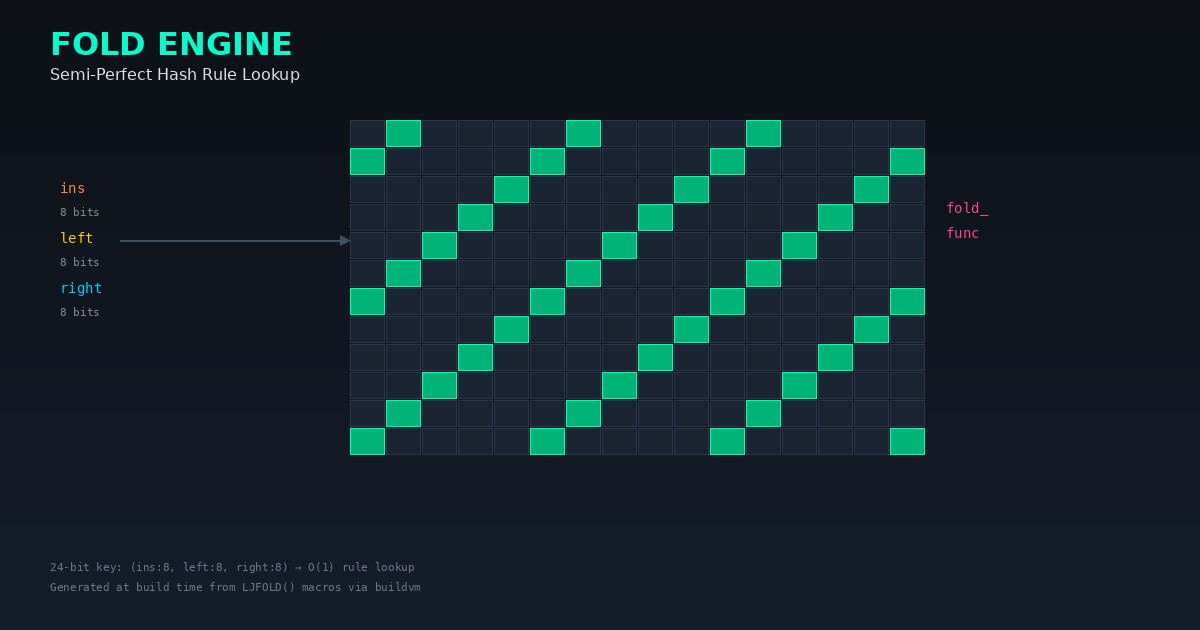
LuaJIT's optimizer fits in 2,653 lines of code. Yet it handles constant folding, algebraic simplification, array-bounds-check elimination, common-subexpression elimination, load forwarding, and dead-store elimination. How?
The answer is the FOLD engine: a rule-based optimizer driven by a semi-perfect hash table generated at build time. Every time an instruction is emitted during trace recording, the FOLD engine checks if any optimization rule applies — in O(1) time, with no string matching, no if-else chains, no visitor patterns.
This is the pinnacle of compile-time metaprogramming: a Lua script scans macro specifications and generates an optimal C lookup table. The result is an optimizer that's fast, extensible, and remarkably compact.
In this article, you'll learn the FOLD engine architecture, the LJFOLD macro system, the semi-perfect hash table, iterative refinement with wildcards, the build-time code generation, and why this design is so elegant.
Key Takeaways
- The FOLD engine is a rule-based optimizer that runs on every emitted instruction during trace recording.
- Rules are defined via
LJFOLD()macros and compiled into a semi-perfect hash table at build time.- The 24-bit key
(ins_opcode, left_opcode, right_opcode)enables O(1) rule lookup.- Iterative refinement with wildcards allows rules to match progressively more general patterns.
- This is compile-time metaprogramming: a Lua script generates the C lookup table from macro specifications.
The FOLD Engine Architecture
The FOLD engine sits at the heart of LuaJIT's optimizer. It runs on every instruction emitted during trace recording — not as a separate pass, but inline with instruction creation.
Where FOLD Fits
 Bytecode → [lj_record_ins()] → emitir(ot, a, b)
                                      │
                              ┌───────▼────────┐
                              │  lj_ir_set()   │  Create IR instruction
                              └───────┬────────┘
                                      │
                              ┌───────▼────────┐
                              │ lj_opt_fold()  │  ← FOLD engine runs here
                              └───────┬────────┘
                                      │
                              ┌───────▼────────┐
                              │  Folded IR     │  Optimized instruction
                              └────────────────┘
The emitir() macro ties it all together:
#define emitir(ot, a, b) (lj_ir_set(J, (ot), (a), (b)), lj_opt_fold(J))This creates the IR instruction, then immediately runs the FOLD engine on it. The fold may:
- Replace the instruction with a constant (constant folding)
- Replace it with an operand (algebraic simplification)
- Mark it for CSE (common-subexpression elimination)
- Leave it unchanged (no rule matched)
Why Fold During Recording?
Most compilers separate instruction selection from optimization. The front end emits IR, then optimization passes transform it. LuaJIT folds during recording because:
- Type information is fresh: Guards have just been emitted, so types are known
- Single pass: No separate optimization pass needed for simple folds
- Smaller IR: Folded instructions don't consume space in the trace
- Better CSE: Constants are available immediately for subsequent instructions
The tradeoff: more work during recording. But recording only happens for hot code, so the cost is amortized.
The LJFOLD Macro System
Optimization rules are defined declaratively via the LJFOLD macro. Each rule specifies: the instruction opcode, the left operand type, the right operand type, and the fold function to call.
Rule Definition
LJFOLD(ADD KNUM KNUM)
  LJFOLD_FUNC(kfold_numarith)
LJFOLD_END

LJFOLD(ADD KINT KINT)
  LJFOLD_FUNC(kfold_intarith)
LJFOLD_END

LJFOLD(FLOAD KGC IRFL_FUNC_FFID)
  LJFOLD_FUNC(fload_func_ffid_kgc)
LJFOLD_END

LJFOLD(XLOAD any any)
  LJFOLD_FUNC(lj_opt_fwd_xload)
LJFOLD_END

LJFOLD(ASTORE any any)
  LJFOLD_FUNC(lj_opt_dse_ahstore)
LJFOLD_END
The syntax: LJFOLD(INSTRUCTION LEFT RIGHT) followed by the fold function name. The any keyword means "match any operand type."
Rule Categories
| Category | Example Rule | What It Does |
|---|---|---|
| Constant folding | ADD KNUM KNUM → compute at record time |
3 + 4 → 7 |
| Algebraic simplification | ADD(x, 0) → x |
Strength reduction |
| ABC elimination | ABC(any, ABC) → nested check |
Array bounds optimization |
| CSE | HREF any any → check chain |
Common subexpression |
| Load forwarding | XLOAD any any → forward store |
Replace load with stored value |
| Dead-store elimination | ASTORE any any → check liveness |
Remove unused stores |
| Guard optimization | FAILFOLD/DROPFOLD |
Remove always-false/true guards |
The Fold Function
Each fold function receives the JIT state and the instruction, and returns a terminal action:
enum {
  NEXTFOLD,     // Continue to next rule
  RETRYFOLD,    // Re-fold the modified instruction
  INTFOLD(k),   // Replace with integer constant k
  LEFTFOLD,     // Replace with left operand
  RIGHTFOLD,    // Replace with right operand
  CSEFOLD,      // Perform CSE
  EMITFOLD,     // Emit the instruction as-is
  FAILFOLD,     // Guard always fails (exit trace)
  DROPFOLD,     // Guard always true (remove it)
};
The Semi-Perfect Hash Table
The FOLD engine's performance comes from its lookup structure: a semi-perfect hash table generated at build time.
The 24-Bit Key
 ┌──────────────┬──────────────┬──────────────┐
 │  ins_opcode  │ left_opcode  │ right_opcode │
 │   (8 bits)   │  (8 bits)    │  (8 bits)    │
 └──────────────┴──────────────┴──────────────┘
       23-16          15-8           7-0
- ins_opcode: The opcode of the instruction being folded (8 bits = 256 possible opcodes)
- left_opcode: The opcode of the left operand (8 bits; 0 if left is a literal/constant)
- right_opcode: The opcode of the right operand (8 bits; 0 if right is a literal/constant)
Literals (constants) use their lowest 8 bits as their "opcode" for hashing purposes. Unused operands use 0.
Why Semi-Perfect?
A perfect hash guarantees O(1) lookup with zero collisions for any key in the domain. A semi-perfect hash guarantees zero collisions for defined keys (keys that have rules) but may have collisions for undefined keys.
This is exactly what the FOLD engine needs: every rule lookup hits exactly one defined rule (or no rule). Undefined keys may hash to occupied slots, but the fold function returns NEXTFOLD to continue searching.
The Generated Table
At build time, buildvm_fold.c generates two arrays:
// Generated by buildvm_fold.c
static const uint16_t fold_hash[DASM_FOLD_HASH_SIZE] = {
  0x0000, 0x0001, 0x0000, 0x0002, ...
};

static const FoldFunc fold_functions[] = {
  kfold_numarith,       // Index 0
  kfold_intarith,       // Index 1
  fload_func_ffid_kgc,  // Index 2
  ...
};
The lookup:
uint32_t key = (ins << 16) | (left << 8) | right;
uint16_t hash = fold_hash[key % DASM_FOLD_HASH_SIZE];
FoldFunc func = fold_functions[hash];
Iterative Refinement — Wildcard Matching
The key insight that makes the FOLD engine powerful: when a specific rule doesn't match, the engine doesn't give up. It masks the key with wildcards and retries, from most-specific to least-specific.
The Four Levels
 Level 1 (exact):     ins=left=ADD, right=KNUM, left_op=KGC, right_op=KNUM
                       → Look up: (ADD, KGC, KNUM)

 Level 2 (wildcard L): ins=left=ADD, right=KNUM, left_op=any, right_op=KNUM
                       → Look up: (ADD, any, KNUM)

 Level 3 (wildcard R): ins=left=ADD, right=KNUM, left_op=KGC, right_op=any
                       → Look up: (ADD, KGC, any)

 Level 4 (wildcard LR): ins=left=ADD, right=KNUM, left_op=any, right_op=any
                       → Look up: (ADD, any, any)
The any mask is defined per-rule, allowing partial wildcards. A rule can specify "match any left operand but a specific right operand."
Why This Matters
Without wildcarding, you'd need a separate rule for every possible combination of operands. With wildcarding, one general rule can handle many specific cases:
// Specific rule: ADD of two known numbers
LJFOLD(ADD KNUM KNUM) → kfold_numarith

// General rule: ADD with any operands (strength reduction)
LJFOLD(ADD any any) → lj_opt_fold_add  // handles x+0, 0+x, etc.
The specific rule fires first. If it doesn't match, the general rule catches the case.
Terminal Actions — What Happens When a Rule Matches
When a fold function executes, it returns a terminal action that determines what happens to the instruction.
The Actions
 ┌─────────────────────────────────────────────────────────────┐
 │  Action        │  Effect                                    │
 ├────────────────┼────────────────────────────────────────────┤
 │  NEXTFOLD      │  Continue searching for another rule       │
 │  RETRYFOLD     │  Re-fold the (modified) instruction        │
 │  INTFOLD(k)    │  Replace with integer constant k           │
 │  LEFTFOLD      │  Replace with left operand                 │
 │  RIGHTFOLD     │  Replace with right operand                │
 │  CSEFOLD       │  Perform common-subexpression elimination  │
 │  EMITFOLD      │  Emit the instruction unchanged            │
 │  FAILFOLD      │  Guard always fails (exit trace)           │
 │  DROPFOLD      │  Guard always true (remove it)             │
 └────────────────┴────────────────────────────────────────────┘
Examples in Action
// Constant folding: ADD(KNUM 3, KNUM 4) → INTFOLD(7)
LJFOLD(ADD KNUM KNUM)
  if (op1->n + op2->n == (int32_t)(op1->n + op2->n))
    return INTFOLD((int32_t)(op1->n + op2->n));
  return NEXTFOLD;
LJFOLD_END

// Strength reduction: ADD(x, KNUM 0) → LEFTFOLD
LJFOLD(ADD any KNUM)
  if (op2->n == 0) return LEFTFOLD;  // x + 0 = x
  return NEXTFOLD;
LJFOLD_END

// Dead store: ASTORE to unread slot → DROPFOLD
LJFOLD(ASTORE any any)
  if (slot_is_dead(op1)) return DROPFOLD;
  return NEXTFOLD;
LJFOLD_END
Build-Time Code Generation — The Meta Trick
The most remarkable aspect of the FOLD engine: the hash table isn't written by hand. It's generated at build time by a Lua script that scans the source code for LJFOLD macros.
The Pipeline
 ┌──────────────────┐     ┌──────────────────┐     ┌──────────────────┐
 │  lj_opt_fold.c   │────▶│  buildvm_fold.c  │────▶│  lj_folddef.h    │
 │  (LJFOLD macros) │     │  (Lua script)    │     │  (generated      │
 │                  │     │  scans & generates│    │   hash table)    │
 └──────────────────┘     └──────────────────┘     └──────────────────┘
        │                                                    │
        │                                                    ▼
        │                                            ┌──────────────────┐
        └───────────────────────────────────────────▶│  Compiled into   │
                                                     │  luajit binary   │
                                                     └──────────────────┘
How It Works
buildvm_fold.c(a C program that runs at build time) scanslj_opt_fold.cforLJFOLD(...)macro invocations- It extracts the instruction, left, right, and function name from each macro
- It builds a hash table mapping 24-bit keys to function indices
- It generates
lj_folddef.h— a C header with thefold_hash[]array andfold_functions[]table
Why This Is "Compile-Time Metaprogramming"
This technique — using a script to generate optimized lookup tables from declarative specifications — is the essence of compile-time metaprogramming:
- Declarative rules: You say what to optimize, not how to match
- Optimal code generation: The generator produces the fastest possible lookup structure
- Zero runtime cost: The hash table is precomputed; no parsing or matching at runtime
- Extensibility: Add a rule → add one macro → rebuild
Comparison: Traditional Approaches
| Approach | Pros | Cons |
|---|---|---|
| If-else chains | Simple to understand | O(n) lookup, hard to maintain |
| Visitor pattern | Extensible, OO | Virtual dispatch overhead, boilerplate |
| String matching | Flexible | Slow, error-prone |
| Semi-perfect hash | O(1), compact, fast | Requires build-time generation |
CSE — Common Subexpression Elimination
The FOLD engine integrates tightly with LuaJIT's CSE mechanism. When a fold returns CSEFOLD, the engine searches for an identical instruction that was already emitted.
The Skip-List Chains
Each opcode has a skip-list chain (J->chain[op]) linking all instructions with that opcode. For CSE, the engine walks the chain looking for an instruction with matching (op1, op2):
// Simplified CSE search
IRRef lj_opt_cse(jit_State *J, IROp op, IRRef op1, IRRef op2) {
  IRRef ref = J->chain[op];
  IRRef lim = op1 > op2 ? op1 : op2;  // Only search predecessors
  while (ref > lim) {
    IRIns *ir = IR(ref);
    if (ir->op1 == op1 && ir->op2 == op2) return ref;  // Found match!
    ref = ir->prev;
  }
  return 0;  // No match
}
The lim bound is key: since references are in SSA order (instructions grow upward), any match must be a predecessor. This bounds the search to O(1) amortized time.
Integration with FOLD
When a fold returns CSEFOLD, the engine runs the CSE search. If a match is found, the current instruction is replaced with the existing reference — no duplicate computation.
Why This Design Is Elegant
The FOLD engine represents a compiler construction technique at its finest. Here's why:
Separation of Concerns
Rules are defined declaratively. The engine handles matching. You don't write matching logic; you write what to optimize. This makes the rules easy to read, verify, and extend.
Extensibility
Adding a new optimization requires one LJFOLD macro and one fold function. No changes to the engine, no changes to the hash table generator (it auto-discovers new rules).
Performance
- O(1) lookup: Single hash table access per instruction
- No string matching: Keys are integers, not strings
- No if-else chains: The hash table replaces what would be hundreds of conditionals
- Compact: 2,653 lines for the entire optimizer
The "Pinnacle of Compile-Time Metaprogramming"
This technique — using a build-time script to generate optimal lookup tables from declarative macro specifications — is the pinnacle of compile-time metaprogramming because:
- The generator is simple: A Lua script scans macros and builds a hash table
- The output is optimal: Semi-perfect hash guarantees O(1) with no collisions for defined keys
- The interface is clean: Rules are declarative, not procedural
- The cost is zero: All computation happens at build time; runtime is just table lookups
This pattern — declarative rules + build-time code generation — is applicable far beyond LuaJIT. Any system that needs fast pattern matching on structured data can benefit from it.
Frequently Asked Questions
Why fold during recording instead of after?
Type information is fresh during recording — guards have just been emitted, so types are known. Folding during recording avoids a separate optimization pass and keeps the IR small. The tradeoff is more work during recording, but recording only happens for hot code.
What happens if two rules match?
The most specific match wins. Iterative refinement tries exact matches first, then progressively wildcards operands. The first rule that returns a terminal action other than NEXTFOLD wins.
Can I add custom fold rules?
Yes. Add a LJFOLD(INSTRUCTION LEFT RIGHT) macro with your fold function, then rebuild. The build-time generator will discover your new rule and include it in the hash table.
How many fold rules are there?
Approximately 200+ rules covering constant folding, algebraic simplification, ABC elimination, CSE, load forwarding, dead-store elimination, and guard optimization. They're defined throughout lj_opt_fold.c.
Is the hash table perfect or semi-perfect?
Semi-perfect. Defined keys (those with rules) have zero collisions. Undefined keys may hash to occupied slots, but the fold function returns NEXTFOLD to continue searching, so this is harmless.
Sources
- Mike Pall, LuaJIT source code (
src/lj_opt_fold.c,src/host/buildvm_fold.c,src/lj_folddef.h), LuaJIT GitHub - Mike Pall, "LuaJIT 2.1 FOLD engine documentation", luajit.org
- Compiler literature: semi-perfect hash tables, Gray code generation for hash functions