How a Double Holds the Entire Lua World: LuaJIT's NaN-Boxing Object Model
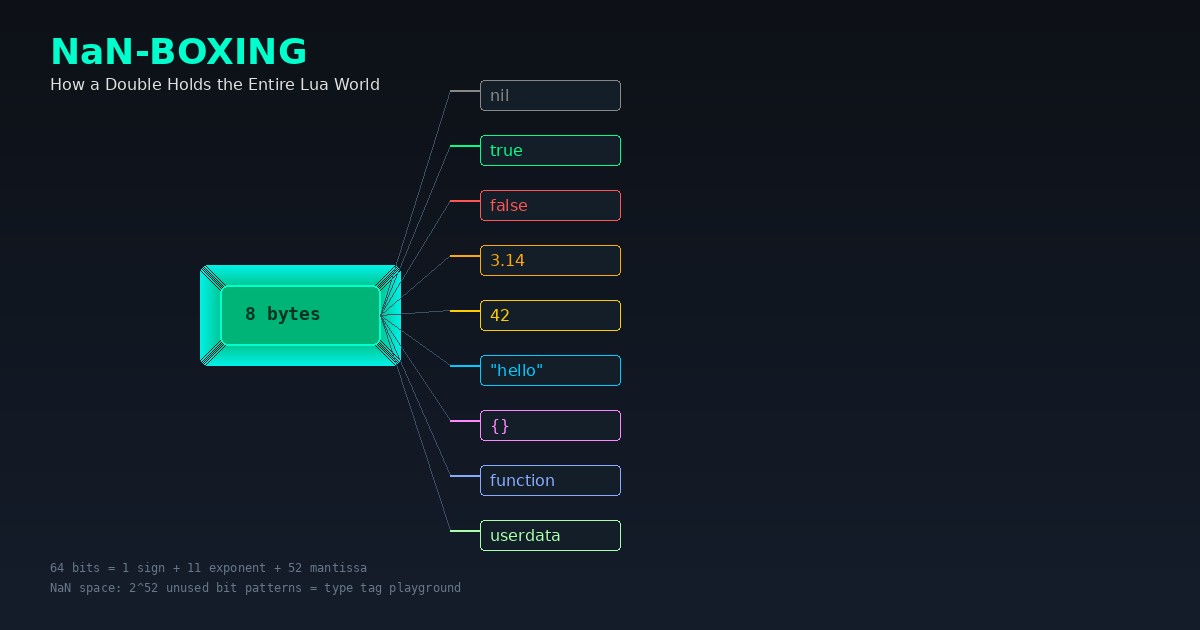
Every Lua value — nil, true, 3.14, "hello", {}, function() end — fits in exactly 8 bytes. Not 16. Not 24. Eight. The same size as a single double.
The trick is called NaN-boxing: a bit-packing technique that exploits the unused bit patterns in IEEE 754 floating-point NaN values to encode type information directly in the value representation. It's the foundation of LuaJIT's object model, and it's why LuaJIT can represent any value in a single machine word with zero overhead for type dispatch.
In this article, you'll learn exactly how NaN-boxing works — from the IEEE 754 bit layout through the TValue union, both GC64 and non-GC64 modes, the GC object hierarchy, dual-number mode, and the write barrier that keeps the garbage collector correct.
Key Takeaways
- NaN-boxing exploits the 2^52 unused NaN bit patterns in IEEE 754 to encode type tags in the top bits of a double.
- A single
TValueunion (8 bytes) holds any Lua value: number, boolean, nil, string pointer, table pointer, etc.- Non-GC64 mode: 32-bit type tag + 32-bit value/pointer. GC64 mode: 13-bit NaN marker + 4-bit tag + 47-bit pointer.
- Dual-number mode stores integers inline, falling back to heap-allocated doubles only when necessary.
- The write barrier invariant (black never points to white) enables incremental GC without stopping the world.
The IEEE 754 NaN Space — A Hidden Playground
To understand NaN-boxing, you first need to understand the IEEE 754 double-precision floating-point format.
The Bit Layout
A 64-bit double is divided into three fields:
 ┌──────────┬───────────────────┬────────────────────────────────────────┐
 │  Sign(1) │   Exponent(11)    │           Mantissa(52)                 │
 │    63    │     62-52         │            51-0                        │
 └──────────┴───────────────────┴────────────────────────────────────────┘
- Sign bit (bit 63): 0 = positive, 1 = negative
- Exponent (bits 62-52): biased by 1023; range 0-2047
- Mantissa (bits 51-0): the fractional part (52 bits of precision)
The value is: (-1)^sign × 2^(exponent-1023) × 1.mantissa
What Makes a NaN
A value is NaN (Not a Number) when:
- The exponent field is all 1s (0x7FF = 2047)
- The mantissa is non-zero
There are two types of NaN:
- Quiet NaN (qNaN): bit 51 (MSB of mantissa) is set → propagates through operations
- Signaling NaN (sNaN): bit 51 is clear → raises an exception on use
The Key Insight
The exponent field has 2048 possible values (0-2047). Two are special:
- 0x000 (all zeros) → zero/denormalized numbers
- 0x7FF (all ones) → infinity/NaN
When the exponent is 0x7FF and the mantissa is non-zero, you have a NaN. With 52 mantissa bits, that's 2^52 - 1 possible NaN values (minus the case where mantissa = 0, which is infinity).
The FPU only generates one specific NaN pattern: 0xFFF8000000000000 (the "canonical quiet NaN"). All other 2^52 - 2 NaN bit patterns are never produced by floating-point operations.
LuaJIT's insight: these unused NaN patterns are a perfect place to hide type tags. The FPU will never generate them, so any value with a NaN bit pattern is guaranteed to be a LuaJIT type tag, not a real number.
The TValue Union — 8 Bytes to Rule Them All
At the heart of LuaJIT's object model is the TValue — a union that can represent any Lua value in exactly 8 bytes.
The Definition
typedef LJ_ALIGN(8) union TValue {
  uint64_t u64;       /* 64-bit pattern overlaps number */
  lua_Number n;       /* Number object overlaps split tag/value object */
#if LJ_GC64
  GCRef gcr;          /* GCobj reference with tag */
  int64_t it64;
  struct { int32_t i; uint32_t it; };  /* Integer value + internal tag */
#else
  struct { union { GCRef gcr; int32_t i; }; uint32_t it; };
#endif
  struct { uint32_t lo; uint32_t hi; } u32;
} TValue;
The same 8 bytes can be interpreted as:
- A full 64-bit double (
noru64) - A 32-bit type tag + 32-bit value/pointer (non-GC64)
- A 47-bit pointer + 4-bit tag + 13-bit NaN marker (GC64)
- Two 32-bit halves (
u32.lo,u32.hi)
Type Checking
To check a value's type, LuaJIT extracts the tag bits:
// Non-GC64: tag is the top 32 bits
#define itype(o)	((o)->it)
// GC64: tag is bits 47-51
#if LJ_GC64
#define itype(o)	((uint32_t)(o)->it64 >> 47)
#endif
Value Extraction
// Extract a GC pointer
#define gcval(o)	((o)->gcr)
// Extract an integer
#define intval(o)	((int32_t)(o)->i)
// Extract a double
#define numV(o)		((o)->n)
The beauty: type checking is a single bit shift and mask. No indirection, no vtable lookup, no separate type field. Just arithmetic on the value itself.
Non-GC64 Mode — 32-bit Tags, 32-bit Pointers
In the original (non-GC64) mode, the TValue layout is straightforward:
 ┌──────────────────────┬──────────────────────┐
 │   Type Tag (32-bit)  │   Value (32-bit)     │
 │      bits 63-32      │      bits 31-0       │
 └──────────────────────┴──────────────────────┘
Internal Type Tags
The type tags are defined as negative numbers (so they overlap the NaN region):
#define LJ_TNIL      (~0u)   /* 0xFFFFFFFF = -1 */
#define LJ_TFALSE    (~1u)   /* 0xFFFFFFFE = -2 */
#define LJ_TTRUE     (~2u)   /* 0xFFFFFFFD = -3 */
#define LJ_TLIGHTUD  (~3u)   /* 0xFFFFFFFC = -4 */
#define LJ_TSTR      (~4u)   /* 0xFFFFFFFB = -5 */
#define LJ_TUPVAL    (~5u)   /* 0xFFFFFFFA = -6 */
#define LJ_TTHREAD   (~6u)   /* 0xFFFFFFF9 = -7 */
#define LJ_TPROTO    (~7u)   /* 0xFFFFFFF8 = -8 */
#define LJ_TFUNC     (~8u)   /* 0xFFFFFFF7 = -9 */
#define LJ_TTRACE    (~9u)   /* 0xFFFFFFF6 = -10 */
#define LJ_TCDATA    (~10u)  /* 0xFFFFFFF5 = -11 */
#define LJ_TTAB      (~11u)  /* 0xFFFFFFF4 = -12 */
#define LJ_TUDATA    (~12u)  /* 0xFFFFFFF3 = -13 */
#define LJ_TNUMX     (~13u)  /* 0xFFFFFFF2 = -14 */
Each tag is one less than the previous, starting from -1 (0xFFFFFFFF). When interpreted as a double, these all fall in the NaN region (exponent = 0x7FF, mantissa non-zero).
How Each Type Fits
 NIL/TRUE/FALSE:          Integer:                 GC Pointer:
 ┌──────────┬──────────┐  ┌──────────┬──────────┐  ┌──────────┬──────────┐
 │ LJ_TNIL  │  (zero)  │  │ LJ_TNUMX │   42     │  │ LJ_TSTR  │  ptr     │
 │ 0xFFFF.. │  0x0000  │  │ 0xFFFE.. │  0x002A  │  │ 0xFFFB.. │  0x1A2B  │
 └──────────┴──────────┘  └──────────┴──────────┘  └──────────┴──────────┘
  Tag only, no payload     Tag + 32-bit integer     Tag + 32-bit pointer

 Double (heap allocated):
 ┌──────────────────────────────────────────────────┐
 │  Full 64-bit double value (tag = LJ_TNUMX)       │
 │  The "pointer" points to a heap-allocated double │
 └──────────────────────────────────────────────────┘
- nil, false, true: The tag IS the value. No payload needed.
nil= tag LJ_TNIL with zero payload. - Integers (dual-number mode): Tag = LJ_TNUMX, lower 32 bits = signed integer value.
- GC pointers (strings, tables, functions): Tag = type-specific, lower 32 bits = pointer to GC object.
- Doubles (when they don't fit inline): Tag = LJ_TNUMX, lower 32 bits = pointer to heap-allocated
lua_Number.
The Limitation
Non-GC64 mode uses 32-bit pointers, limiting the address space to 4GB. For most Lua applications this is fine, but for servers or games with large memory footprints, it's a constraint. This is why GC64 mode exists.
GC64 Mode — 64-bit Pointers in 8 Bytes
Modern 64-bit systems can address far more than 4GB. GC64 mode extends LuaJIT to use full 64-bit pointers — still in 8 bytes.
The Layout
 ┌────────────┬──────────┬────────────────────────────────────────────┐
 │ NaN(13-bit)│Tag(4-bit)│         Pointer (47-bit)                   │
 │ bits 63-52 │ bits 51-48│            bits 47-0                       │
 └────────────┴──────────┴────────────────────────────────────────────┘
- Top 13 bits: all 1s (0x1FFF) — the NaN marker
- Next 4 bits: type tag (supports up to 16 types)
- Bottom 47 bits: the actual pointer (128TB addressable)
Why 47 Bits?
x86-64 processors use 48-bit virtual addresses (with sign extension to 64 bits). User-space addresses are limited to 48 bits, and LuaJIT uses 47 of them — giving 128TB of addressable space. More than enough for any Lua program.
Type Checking in GC64
#if LJ_GC64
#define itype(o)  ((uint32_t)(o)->it64 >> 47)
#endif
The tag is extracted by shifting right 47 bits. The top 13 bits being all 1s confirms this is a NaN-boxed value (not a real double).
The Tradeoff
GC64 mode requires more complex type checking (shift + mask vs simple extract) and slightly more complex pointer handling. But it enables LuaJIT to use the full 64-bit address space — essential for modern applications.
The GC Object Hierarchy — Everything is a GCobj
Every garbage-collected object in LuaJIT shares a common header:
#define GCHeader GCRef nextgc; uint8_t marked; uint8_t gctnextgc: pointer to the next GC object in the chainmarked: color bits for tri-color GC (white/gray/black + flags)gct: the GC type (distinguishes strings from tables from functions)
The GCobj Union
typedef union GCobj {
  GChead gch;     /* Common header */
  GCstr str;      /* String */
  GCupval uv;     /* Upvalue */
  lua_State th;   /* Thread */
  GCproto pt;     /* Prototype */
  GCfunc fn;      /* Function (closure) */
  GCcdata cd;     /* C data (FFI) */
  GCtab tab;      /* Table */
  GCudata ud;     /* Userdata */
} GCobj;
┌─────────┐
│GCHeader │
│nextgc │
│marked │
│gct │
└────┬────┘
┌──────────────┼──────────────┐
│ │ │
┌─────┴─────┐ ┌────┴────┐ ┌─────┴─────┐
│ GCstr │ │ GCtab │ │ GCfunc │
│ │ │ │ │ │
│ hash │ │ array │ │ ffid │
│ len │ │ hash │ │ pc │
│ data[] │ │ metatable│ │ upvalues │
└───────────┘ └─────────┘ └───────────┘
Key GC Object Types
GCstr (String): Header + hash algorithm + string ID + hash + length + data. Strings are interned — identical strings share the same object.
GCtab (Table): Header + array part (fast integer keys) + hash part (other keys) + metatable. Tables are the only data structure in Lua — they're used for arrays, objects, dictionaries, and modules.
GCfunc (Function): Header + function ID (ffid) + upvalue pointers. Distinguishes C functions (ffid > 0) from Lua functions (ffid = 0).
GCproto (Prototype): Header + bytecode + constants + upvalue info + debug info. The compiled representation of a Lua function.
GCcdata (C Data): Header + C type ID + data. Used by the FFI to represent C types.
GCudata (Userdata): Header + userdata type + environment + length + data. Raw memory blocks with optional metatable.
GCupval (Upvalue): Header + closed flag + value pointer. Represents variables from enclosing scopes.
The gct Field
The gct field in the header distinguishes object types during GC traversal:
#define LJ_TSTR    (~4u)
#define LJ_TUPVAL  (~5u)
#define LJ_TTHREAD (~6u)
#define LJ_TPROTO  (~7u)
#define LJ_TFUNC   (~8u)
#define LJ_TTRACE  (~9u)
#define LJ_TCDATA  (~10u)
#define LJ_TTAB    (~11u)
#define LJ_TUDATA  (~12u)
When the GC traverses an object, it switches on gct to call the appropriate traversal function (marking the object's children).
Dual-Number Mode — Integers Without Allocation
Lua 5.1 specifies that all numbers are doubles. But allocating a heap object for every integer is wasteful. LuaJIT's dual-number mode (LJ_DUALNUM) solves this.
The Problem
local x = 0
for i = 1, 1000000 do
  x = x + 1    -- If every integer is heap-allocated, this creates 1M objects!
end
Without dual-number mode, every integer operation would allocate a heap object, trigger GC pressure, and be slow.
The Solution
Dual-number mode stores integers inline in the TValue when possible:
 Integer (inline):        Double (heap-allocated):
 ┌──────────┬──────────┐  ┌──────────┬──────────┐
 │ LJ_TNUMX │   42     │  │ LJ_TNUMX │  ptr     │
 │ 0xFFFE.. │  0x002A  │  │ 0xFFFE.. │  0x1A2B  │
 └──────────┴──────────┘  └──────────┴──────────┘
  Tag + 32-bit integer     Tag + pointer to heap double
- Inline integer: Tag = LJ_TNUMX, lower 32 bits = signed integer value. No heap allocation.
- Heap double: Tag = LJ_TNUMX, lower 32 bits = pointer to heap-allocated
lua_Number.
Type Checking
// Is this value an inline integer?
#define tvisint(o)	(itype(o) == LJ_TNUMX && (int32_t)(o)->i != 0)
// Is this value a heap double?
#define tvisnum(o)	(itype(o) == LJ_TNUMX && !tvisint(o))
Wait — both have tag LJ_TNUMX. How do you distinguish them? The trick: integers are stored with the tag in the upper bits and the integer in the lower bits. A heap double's pointer, when interpreted as two 32-bit halves, has a different pattern. The actual check is more subtle — it relies on the fact that pointer values (being large) have different bit patterns than small integers.
Performance Impact
With dual-number mode:
- Integer arithmetic: no heap allocation, no GC pressure, single instruction
- Mixed integer/float: automatic promotion to double when needed
- Overflow: when an integer exceeds 32-bit range, it's promoted to a heap double
This is critical for performance: most loops use integers, and avoiding allocation for them is a massive win.
The Write Barrier — Keeping the GC Correct
LuaJIT uses an incremental tri-color mark-sweep GC. The tri-color abstraction:
- White: Not yet reached (candidate for collection)
- Gray: Reached but not yet scanned (children not marked)
- Black: Reached and scanned (children marked)
The Invariant
A black object never points to a white object.
This is the fundamental invariant of incremental GC. If it holds, the GC can safely collect white objects — they're unreachable.
Why the Invariant Can Break
During the propagate phase, the GC is turning gray objects black. Meanwhile, the mutator (running Lua code) is modifying objects. Consider:
- Object A is black (already scanned)
- Lua code executes:
A.field = Bwhere B is white - Now A (black) points to B (white) — invariant violated!
- The GC might finish marking without ever reaching B → B is incorrectly collected
The Write Barrier
The write barrier detects and repairs invariant violations. When a black object gets a new reference to a white object:
Forward barrier (lj_gc_barrierf): For non-table objects — either mark the white object (move the frontier forward) or re-gray the black object.
Backward barrier (lj_gc_barrierback): For tables — move the table back to the gray (grayagain) list. Cheaper because tables are mutated frequently.
 Mutator writes: A.field = B     (A is black, B is white)

 ┌──────────┐                ┌──────────┐
 │  A       │                │  B       │
 │ (black)  │───field──────▶│ (white)  │
 └──────────┘                └──────────┘
       │
       │ Write barrier fires:
       │ Option 1: Mark B (make it gray)
       │ Option 2: Re-gray A (move back to grayagain)
       ▼
 ┌──────────┐                ┌──────────┐
 │  A       │                │  B       │
 │ (black)  │───field──────▶│ (gray)   │  ← invariant restored
 └──────────┘                └──────────┘
Why Backward Barriers for Tables?
Tables are the most frequently mutated objects in Lua. Using forward barriers would require marking the value being stored on every table assignment — expensive when you're doing millions of table writes. Backward barriers are cheaper: just re-gray the table itself, and the GC will re-scan it later.
The Upvalue Barrier
When an upvalue is closed (its variable goes out of scope), the GC must ensure the closed value doesn't point to a collected object. The upvalue barrier (lj_gc_barrieruv) handles this case specially.
Why NaN-Boxing Matters — Performance Implications
NaN-boxing isn't just clever — it has real performance consequences.
Zero Space Overhead
Every Lua value is exactly 8 bytes. One x86-64 cache line (64 bytes) holds 8 values. Compare:
 LuaJIT (NaN-boxing):     V8 (tagged pointers):     CPython (PyObject):
 ┌──────────────────┐     ┌──────────────────┐     ┌──────────────────┐
 │ 8 bytes/value    │     │ 8 bytes/value    │     │ 16 bytes header  │
 │ No extra header  │     │ + hidden class   │     │ + 8 byte pointer │
 │ Type in bits     │     │ Type in pointer  │     │ Type in header   │
 └──────────────────┘     └──────────────────┘     └──────────────────┘
 ~8 bytes effective       ~8-16 bytes effective    ~24+ bytes effective
Fast Type Checking
Type checking is a bit mask and comparison — single instruction. No vtable lookup, no indirection:
// LuaJIT: type check is one instruction
if (itype(o) == LJ_TTAB) { ... }

// CPython: type check is a pointer dereference
if (Py_TYPE(o) == &PyList_Type) { ... }
Integer Arithmetic Without Allocation
Dual-number mode means integer loops don't allocate. Compare:
-- LuaJIT: no allocation for integers
local x = 0
for i = 1, 1000000 do x = x + 1 end  -- zero allocations

-- Without dual-number mode: 1,000,000 heap allocations
Cache Efficiency
Compact values mean more values fit in cache. A table with 1000 array elements takes ~8KB in LuaJIT (fits in L2 cache) vs ~16-24KB in CPython (may not fit).
The Tradeoff
NaN-boxing requires more complex type checking (bit manipulation) and limits the pointer space (47 bits in GC64, 32 bits in non-GC64). But for a scripting language where values are small and numerous, the space savings dominate.
Frequently Asked Questions
Why NaN specifically?
NaN bit patterns are guaranteed never to be generated by the FPU. Any value with a NaN bit pattern is guaranteed to be a LuaJIT type tag, not a real number. This makes type checking safe — you'll never confuse a real double with a type tag.
What happens if a NaN is actually computed?
LuaJIT's canonical NaN is 0xFFF8000000000000. If the FPU computes a NaN (e.g., 0/0), it produces this specific pattern, which LuaJIT recognizes as "not a number" (the LJ_TNUMX tag with a NaN payload). All other NaN bit patterns are type tags.
Is NaN-boxing unique to LuaJIT?
No. JavaScriptCore (WebKit's JavaScript engine) uses NaN-boxing too. LuaJIT popularized it for dynamic languages, but the technique predates it. The key insight — using unused IEEE 754 bit patterns for type tags — is applicable to any language implementation.
How does GC64 affect performance?
GC64 mode requires slightly more complex type checking (shift right 47 bits vs extract top 32 bits) and pointer masking. The overhead is minimal (1-2 extra instructions per type check) but measurable in tight loops. The benefit — 128TB address space vs 4GB — is essential for modern applications.
Can I disable dual-number mode?
Yes. Compile LuaJIT without LJ_DUALNUM — all numbers become heap-allocated doubles. This simplifies the implementation (no integer/double distinction) but significantly impacts performance for integer-heavy code.
Sources
- Mike Pall, LuaJIT source code (
src/lj_obj.h,src/lj_gc.h,src/lj_gc.c,src/lj_obj.c), LuaJIT GitHub - IEEE 754-2008 floating-point standard
- Mike Pall, "LuaJIT 2.1 documentation", luajit.org
- JavaScriptCore (WebKit) — also uses NaN-boxing for JavaScript values