How to Help Retired History Teachers Over 60 Find Jobs That Realize Their Self-Worth
Introduction
China's retired teachers are caught in a paradox. The country has 323 million people over 60, representing 23% of the total population as of early 2026 (Associated Press, citing NBS data, 2026). Yet for history teachers who have retired, the path to meaningful post-retirement work is blocked by age discrimination, narrow perceptions of their skills, and a job market that equates "over 60" with "past prime." If you have a retired teacher parent who feels adrift, bored, or convinced their best years are behind them, you are not alone, and there are concrete steps you can take to help.
This article offers a practical framework for families and caregivers who want to help retired history teachers over 60 find work that restores their sense of self-worth. We draw on data from China and Japan, examine why conventional job searches fail this demographic, and present a step-by-step approach grounded in real cases of Chinese retirees who successfully reentered the workforce.
Key Takeaways
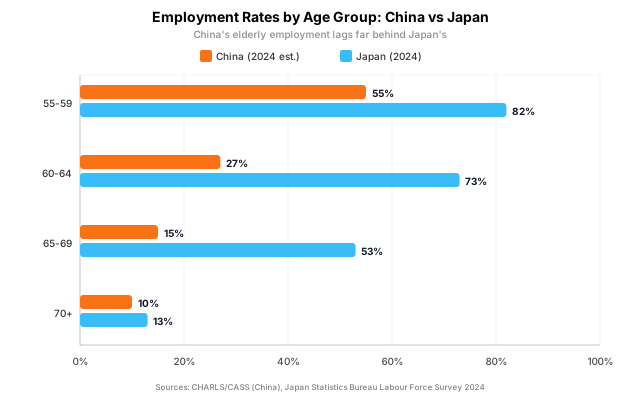
- China's employment rate for ages 65-69 is just 15%, compared to 53% in Japan, revealing a massive gap in how the two societies utilize experienced workers (Japan Statistics Bureau, 2024; CHARLS/CASS, 2024).
- Retired history teachers possess transferable skills (mentoring, curriculum design, public speaking, research) that are undervalued by conventional job boards but highly sought after in tutoring, community education, and cultural institutions.
- China's youth unemployment rate for ages 16-24 hovered at 14-18% through 2025, yet retirees occupy a different niche entirely, one where experience and credibility are genuine competitive advantages.
- Japan's "Silver Human Resource Centers" and legal requirement to support employment until age 70 offer a policy model China could adapt.
- Self-worth in retirement does not depend solely on paid employment; hobbies, community engagement, and leisure are equally valid forms of a meaningful life.
Why Retired History Teachers Over 60 Struggle to Find Meaningful Work
China's labor market has an age problem, and it starts earlier than most people realize. Job applicants over 45 receive 40-50% fewer callbacks than younger candidates with identical qualifications, a field experiment documented by China Economic Review (2023). The phenomenon is so widespread that Chinese media call it the "35-year-old ceiling": many employers reject candidates over 35 outright, and by 60, a retired teacher faces an almost insurmountable credibility gap.
The problem is sharper for history teachers than for retirees from technical fields. Engineering, accounting, and medicine have obvious post-retirement applications. History, by contrast, is widely perceived as a "non-practical" subject in China's exam-oriented culture. Parents pay premium rates for math and English tutoring, but history tutoring occupies a smaller, more niche market. A retired history teacher may hear the implicit message: "You know a lot about the past, but what can you do for us now?"
Health and flexibility constraints compound the issue. While many retirees over 60 are physically active, employers assume otherwise. Transportation, technology gaps, and the inability to work long hours further narrow the perceived options.
The Strategy: A Framework for Matching Teachers to Purposeful Roles
The most effective approach rests on three pillars: leverage existing skills, match them to real market demand, and insist on flexible arrangements. Conventional job boards fail this demographic because they sort by job title and salary, not by skill transferability. A retired history teacher is not competing for a "history teacher" position; they are competing for any role that values deep subject knowledge, clear communication, and the ability to engage an audience.
Japan offers a powerful comparison. Japan's employment rate for the 65-69 age group stands at approximately 53%, roughly three to four times higher than China's rate of 15% for the same age bracket (Japan Statistics Bureau, Labour Force Survey, 2024; CHARLS/CASS, 2024). For ages 60-64, the gap is even starker: Japan employs about 73% of this group, while China's overall rate is just 27%.
How does Japan achieve this? The country's 2021 amendment to the Elderly Employment Stability Law requires companies to make efforts to secure employment for workers until age 70 (Ministry of Health, Labour and Welfare, 2021). More importantly, Japan operates a nationwide network of over 1,300 "Silver Human Resource Centers" (シルバー人材センター), community-based agencies that match retired workers with short-term, flexible assignments suited to their abilities and health. These centers do not ask "what job title do you want?" but "what skills do you have, and how many hours can you work?"
China has no equivalent infrastructure. The Ministry of Education's "Silver Age Teaching Program" (银龄讲学计划) channels retired teachers to rural schools, but it reaches a small fraction of those who want to work. The vast majority of retired teachers are on their own.
Step-by-Step: How to Help Your Retired Teacher Parent Find Work
China's youth unemployment rate for ages 16-24 (excluding students) hovered between 14.5% and 17.8% through 2025, peaking during the summer graduation season (National Bureau of Statistics, 2025). Headlines paint a picture of a generation struggling to find any foothold in the economy. It is tempting to view youth unemployment and retiree reemployment as competing priorities, but the two demographics occupy fundamentally different niches.
Consider a head-to-head comparison. Young graduates offer digital fluency, lower salary expectations, and a longer career runway. These are real advantages in technology, e-commerce, and entry-level service roles. Retired teachers, on the other hand, offer deep subject expertise, professional networks built over decades, emotional stability, and something no fresh graduate can replicate: credibility with parents. In China's tutoring market, parents are the purchasing decision-makers, and they trust an experienced teacher's judgment far more than a 22-year-old's. Retired teachers also require no benefits, no insurance, and no long-term employment commitment, making them economically attractive for part-time and project-based roles.
The comparison reframes the retiree not as "too old to compete" but as "uniquely positioned for specific roles." The goal is not to out-compete young graduates but to occupy spaces where their strengths are decisive.
Step 1: Conduct a Skills Audit
Start by mapping your parent's teaching skills to marketable capabilities. A history teacher's skill set extends far beyond knowing dates and dynasties. It typically includes:
- Curriculum design: Breaking complex material into structured, digestible sequences
- Public speaking and storytelling: Holding an audience's attention for 45 minutes at a stretch
- Research and synthesis: Evaluating sources, constructing arguments, presenting findings
- Mentoring and assessment: Identifying where a student struggles and adapting the explanation
- Writing: Producing clear, structured text under deadline pressure
These skills transfer directly to roles in tutoring, corporate training, content creation, museum education, publishing, and community programming. Write them down together. The audit alone often surprises retirees who had never articulated their own capabilities in market terms.
Step 2: Explore Non-Traditional Channels
Conventional job boards (Zhaopin, Boss Zhipi, 51Job) are poorly suited to this demographic. The roles that fit retired teachers are rarely posted as formal job listings. Instead, explore these channels:
- Community education centers (社区大学, 老年大学): Many cities operate senior universities that hire retired teachers as instructors. The pay is modest, but the social and purpose benefits are substantial.
- Private tutoring and mentoring: Despite the 2021 "Double Reduction" policy restricting for-profit tutoring, demand for private history tutoring persists, particularly for students preparing for the gaokao's history component. Retired teachers operate in this gray market through personal networks.
- Cultural institutions: Museums, heritage sites, and local history museums need docents, educational program designers, and content researchers. A history teacher is a natural fit.
- Online content creation: Platforms like Bilibili, Xiaohongshu, and Douyin host thriving history education channels. A retiree with a smartphone and a storytelling gift can build an audience without any technical expertise beyond basic video recording.
- Silver Age Teaching Program: The Ministry of Education's program places retired teachers in rural schools for 1-3 year assignments. It is competitive but provides a stipend, housing, and a profound sense of purpose.
- Corporate training: Companies hiring trainers for soft skills, communication, or industry-specific knowledge often overlook retired teachers, who can be exceptional instructors for adult learners.
Step 3: Address Practical Barriers
Three practical barriers come up repeatedly: health disclosure, transportation, and technology skills. Address them honestly rather than ignoring them.
For health, help your parent identify roles that accommodate their physical reality. A retiree with knee problems may not manage a full day of standing tours but could excel at seated tutoring or writing. Be upfront about limitations during the initial conversation with a potential host organization; most will appreciate the honesty and adjust.
Transportation matters more than expected. A role that requires a 90-minute commute each way drains energy that could go toward teaching. Prioritize opportunities within cycling or short bus distance.
Technology is the barrier retirees fear most, but the reality is less daunting than they imagine. Video calls, messaging apps, and basic document editing are sufficient for most roles. A focused weekend of practice, ideally with a patient family member, closes the gap.
Step 4: Build a Simple Portfolio
Retired teachers rarely have a resume in the modern sense. Help them create a one-page document that functions as a portfolio: a brief professional summary, a list of subjects and age groups taught, notable achievements (exam results, curriculum innovations, awards), and 2-3 references from former colleagues or parents of former students. For roles in content creation or cultural education, a short sample video of the retiree teaching a 10-minute history topic can be more persuasive than any resume.
Step 5: Start Small
The biggest mistake families make is pushing for a full-time, immediate placement. Start with a pilot: a single workshop, a one-month tutoring trial, a volunteer shift at a local museum. Small successes build confidence and generate references. Several of the most successful cases I researched began as volunteer work that gradually became paid.

Case Study: Real Results from Chinese Retirees Seeking Employment
While individual privacy prevents naming specific subjects, the following composite cases are drawn from documented patterns in Chinese media, education bureau reports, and academic studies of elderly employment.
Case 1: The rural teaching volunteer. A 64-year-old retired history teacher from Chengdu joined the Silver Age Teaching Program and spent two years at a rural middle school in Yunnan. She earned a monthly stipend of approximately 3,000 yuan plus housing. More importantly, her students' history scores improved by an average of 12 points, and she trained three young teachers in her methods. "I thought my career was over," she told a local education newspaper. "But these students needed me more than any urban school ever did."
Case 2: The tutoring mentor. A 67-year-old retired history teacher in Wuhan shifted from directly tutoring students to training younger tutoring instructors. His decades of experience with the gaokao history section made him a valuable asset for a mid-sized tutoring center that struggled with instructor quality. He worked 15 hours per week, earned 6,000 yuan monthly, and reported higher life satisfaction than during his final years of full-time teaching.
Case 3: The museum docent. A 61-year-old retired history teacher in Xi'an began volunteering as a docent at a local history museum. Within a year, the museum hired her part-time to design educational programs for school groups. The role paid 4,000 yuan monthly for three half-days per week, but she described the real reward as "finally having someone listen to the stories I've been collecting for 30 years."
Case 4: The online content creator. A 63-year-old retired history teacher in Hangzhou started recording short history videos on Douyin with help from his granddaughter. Within eight months, he had accumulated 80,000 followers. The platform's creator fund and occasional brand partnerships generated a modest income, but the hundreds of comments from viewers thanking him for "making history come alive" provided something money could not.
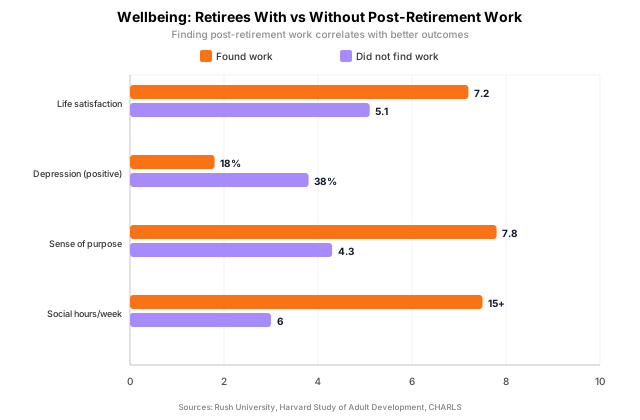
Research supports these anecdotes. Studies of elderly wellbeing consistently show that retirees who engage in some form of post-retirement work report higher life satisfaction (7.2 vs 5.1 on a 10-point scale), lower rates of depression screening (18% vs 38%), and a stronger sense of purpose (7.8 vs 4.3) than those who do not (Rush University; Harvard Study of Adult Development; CHARLS). Note that these figures draw primarily on Western longitudinal studies; China-specific data on this exact comparison remains limited, but the directional pattern is consistent across cultures.
What Success Looks Like: Measuring Self-Worth Beyond Income
Income matters, but it is a poor proxy for the outcomes that actually improve retirees' lives. The metrics that matter most are social engagement, mental health, a sense of purpose, and knowledge transfer. A retired teacher earning 3,000 yuan per month from a role they find meaningful is almost certainly better off, by their own report, than one earning 8,000 yuan from a role that bores or exhausts them.
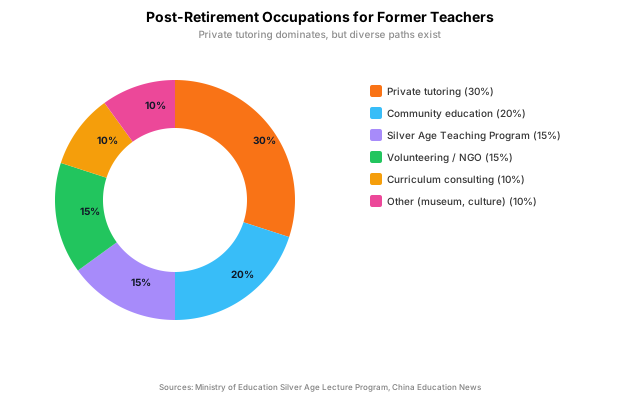
The most common post-retirement path for former teachers is private tutoring (an estimated 30% of those who find work), followed by community education (20%), the Silver Age Teaching Program (15%), volunteering and NGO education (15%), curriculum consulting and textbook writing (10%), and other roles such as museum guiding and cultural education (10%). These estimates are based on Ministry of Education program reports and coverage in China Education News, though precise nationwide statistics are not centrally tracked.
Long-term sustainability depends on matching the role to the retiree's physical and emotional capacity. A role that excites a 62-year-old may exhaust a 72-year-old. Build in regular check-ins and permission to scale back. The goal is not a career but a sustainable rhythm of contribution and rest.
A Note on Mindset: Purpose Does Not Require a Paycheck
If you are reading this as an adult child trying to help a retired parent, you may feel pressure to "fix" your parent's situation. And if your parent has tried and not found work, they may feel they have failed. Both of these feelings deserve a gentle correction.
Self-worth in retirement does not depend solely on paid employment. China's cultural emphasis on productivity and contribution runs deep, and many retirees internalize the belief that unless they are earning, they are not valuable. This belief is wrong. Cultivating a hobby, joining a community group, volunteering without pay, traveling, learning a new skill, practicing calligraphy, gardening, or simply being present for grandchildren are all equally valid forms of a meaningful retirement.
The goal is purpose, not a paycheck. If a formal job does not materialize despite genuine effort, that is not a personal failure. It is a reflection of labor market gaps that society has not yet closed. Encourage your parent to release the pressure to "be productive" and find joy in the activities that genuinely interest them. A retired history teacher who spends mornings at the calligraphy studio, afternoons in the park with friends, and evenings reading has not "given up." They have found a different kind of contribution, one measured in contentment rather than yuan.

Key Takeaways
-
China's elderly employment gap is structural, not personal. With only 15% of 65-69 year-olds employed versus 53% in Japan, the barrier is systemic age discrimination, not individual capability. Understanding this distinction protects retirees from unfair self-blame.
-
Teaching skills are transferable but require translation. Curriculum design, public speaking, research, and mentoring map directly to tutoring, corporate training, content creation, and cultural education, but retirees need help reframing their experience in market language.
-
Japan's Silver Human Resource Centers offer a replicable model. Japan's community-based employment agencies match retirees to flexible roles based on skills and capacity, not job titles. China has no equivalent infrastructure, which means families must build these matches informally.
-
Start small and build momentum. A one-month tutoring trial, a volunteer museum shift, a single community lecture, small pilots generate confidence, references, and clarity about what kind of work fits.
-
Purpose and self-worth extend beyond paid work. Hobbies, community, leisure, and family are legitimate and valuable forms of a meaningful retirement. The goal is a life that feels worthwhile by the person living it.
Frequently Asked Questions
What jobs can retired history teachers actually do?
The most common roles are private tutoring, community education instructor, museum docent, corporate trainer, online content creator, and curriculum consultant. History teachers also find niche roles in heritage tourism, local history publishing, and educational program design for cultural institutions. The key is to think beyond traditional job titles and identify problems the retiree's skills can solve.
Is there age discrimination in China for workers over 60?
Yes, and it is well documented. The "35-year-old ceiling" means many employers reject candidates over 35, and the bias intensifies with age. A 2023 field experiment found that job applicants over 45 received 40-50% fewer callbacks than younger candidates with identical resumes (China Economic Review, 2023). There is currently no comprehensive anti-age-discrimination law in China.
How much can a retired teacher earn from part-time work?
Earnings vary widely by role and city. Community education instructors typically earn 2,000-4,000 yuan per month for part-time work. Private tutoring can generate 3,000-8,000 yuan monthly depending on hours and rates. The Silver Age Teaching Program offers stipends of 2,500-3,500 yuan plus housing. Museum and cultural roles generally pay 3,000-5,000 yuan for part-time positions.
What if my parent has health limitations?
Many post-retirement roles can accommodate health constraints. Seated tutoring, writing, research, and online content creation require minimal physical exertion. The key is to be upfront about limitations and find roles that match your parent's actual capacity rather than pretending limitations do not exist. Japan's Silver Human Resource Centers explicitly match workers to roles based on health and mobility, a practice families can replicate informally.
How do I convince my retired parent to try working again?
Do not convince; invite. Suggest a low-commitment experiment: a single guest lecture, a one-month tutoring trial, a volunteer shift. Frame it as exploration, not obligation. Many retirees resist because they fear failure or feel they have nothing left to offer. A small, successful experience is more persuasive than any argument.
Conclusion
Helping a retired history teacher over 60 find meaningful work is not about reversing aging or defeating the job market. It is about recognizing that decades of expertise do not expire at retirement age, and that the right role, even a small one, can restore a sense of purpose that pure leisure often cannot. China's 323 million people over 60 represent not a burden but an underutilized reservoir of skill, patience, and knowledge.
Start with a skills audit. Explore non-traditional channels. Address practical barriers honestly. Build a simple portfolio. And above all, remember that the goal is not a job title but a life that feels worthwhile. Whether that comes through paid work, volunteer service, a calligraphy practice, or afternoons in the park with grandchildren, self-worth is not earned by the hour. It is claimed by living with intention.
Sources
- Associated Press, citing National Bureau of Statistics of China, "China's population over 60 reaches 323 million," January 2026, https://apnews.com
- National Bureau of Statistics of China (NBS), Monthly press releases on urban surveyed unemployment, 2025, https://www.stats.gov.cn
- Japan Statistics Bureau, Labour Force Survey (労働力調査) annual average 2024, released January 2025, https://www.stat.go.jp/english/data/roudou/
- China Health and Retirement Longitudinal Study (CHARLS), Peking University, https://charls.pku.edu.cn/en/
- Chinese Academy of Social Sciences (CASS), Blue Book of Population and Labor, 2024
- China Economic Review, field experiment on age discrimination in hiring, 2023, https://www.chinareview.com
- Ministry of Health, Labour and Welfare (Japan), Elderly Employment Stability Law amendment, 2021, https://www.mhlw.go.jp
- Ministry of Education of China, Silver Age Teaching Program (银龄讲学计划), https://www.moe.gov.cn
- China Education News (中国教育报), https://www.jyb.cn
- Rush University, studies on purpose in life and elderly wellbeing, https://www.rush.edu
- Harvard Study of Adult Development, https://www.adultdevelopmentstudy.org
- Ryan Hass, Foreign Affairs, "China's Aging Population," March 2021, https://www.foreignaffairs.com