How to Negotiate with Landlords in Shanghai's Second-Hand Market (2026)

How to Negotiate with Landlords in Shanghai's Second-Hand Market (2026)
If you are a first-time buyer shopping for a second-hand apartment in Shanghai, the asking price on the listing is not the price you should pay — and the gap between the two has widened into real money. As of 2025, Shanghai's second-hand listing-to-transaction ratio sat at roughly 94.5%, meaning buyers who negotiated saved an average of 5.5% off the sticker price (Beike Research Institute, 2025). On a CNY5 million apartment, that is CNY275,000 — more than many couples earn in a year. Yet most first-time buyers treat the listing price as a starting point rather than a ceiling, and they close at or near ask.
Shanghai's second-hand market in 2026 is a buyer's market by every structural measure: inventory above 180,000 units, average time on market of 90–120 days, and a price index still roughly 20% below its 2021 peak. The leverage exists. The question is whether you know how to use it.
This guide walks you through a research-backed negotiation framework built on Shanghai transaction data: how to read the market, how to size up your specific landlord, how to build an offer the numbers support, and how to close without leaving money on the table.
Key Takeaways
- Shanghai's second-hand price index sits roughly 20% below its 2021 peak, with inventory exceeding 180,000 units — a structurally favorable market for buyers (Beike Research Institute, 2025–2026).
- Average city-wide negotiation room runs 5–8%, but outer-ring districts offer 8–15% and far suburbs 15–20%+ below asking.
- The single strongest leverage signal is a landlord in a chain transaction (连环单): 50–60% of sellers are also buyers with hard deadlines.
- First-time buyers should open at 8–10% below asking in mid/outer-ring districts, anchored to comparable transactions — not the listing price.
What Market Conditions Give You Leverage in 2026?
In 2026, Shanghai's second-hand housing inventory stands above 180,000 active listings, with an absorption cycle of roughly 9–11 months at current transaction velocity (CRIC, 2025 Q4). That oversupply is the foundation of buyer leverage: sellers compete for a limited pool of qualified buyers, and time is not on their side.
The price data tells the same story. Shanghai's second-hand price index peaked in early 2021 and has since fallen roughly 20% to a Q1 2026 level of approximately 82 (Q1 2021 = 100), according to aggregated data from Beike Research Institute, CRIC, and the National Bureau of Statistics (2025–2026). Core districts have held up better — inner-ring prices are only 8–12% off peak — but outer-ring and far-suburb segments have absorbed the bulk of the decline. The market has not crashed. It has normalized, and normalization favors the patient buyer.
Transaction volume recovered to roughly 220,000–240,000 units in 2025, up 8–10% year-on-year, with second-hand homes accounting for 68% of all residential transactions (CRIC, 2025). Volume without price recovery is the signature of a transitional buyer's market: confident buyers are closing, but the marginal buyer — the one who would bid above ask — is absent. That absence is your opening.
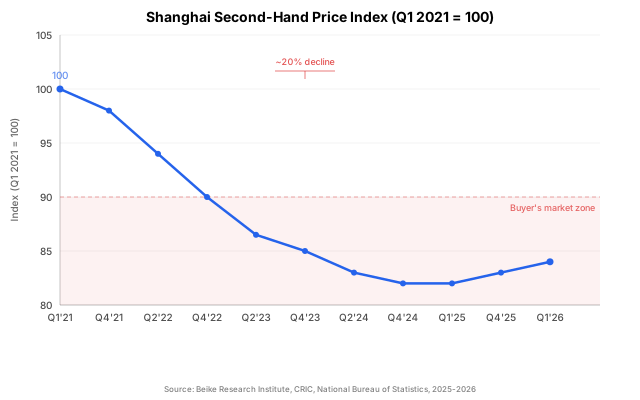
In 2026, Shanghai's second-hand price index sits at roughly 82 (Q1 2021 = 100), down about 20% from its peak and stabilizing in the 80–82 range since late 2024 (Beike Research Institute, CRIC, NBS, 2025–2026). Inventory absorption of 9–11 months confirms sustained buyer leverage across most district tiers.
The district-level picture matters enormously. Inner-ring districts (Huangpu, Jing'an, Xuhui, Changning) have the tightest supply and the most school-district-driven demand, so negotiation room there is narrowest: 3–5% off asking is a realistic outcome. The middle ring (Putuo, Yangpu, Hongkou, inner Pudong) offers 5–10%. Outer-ring districts (Baoshan, Minhang, Jiading, Songjiang) and far suburbs (Qingpu, Fengxian, Jinshan) are where the leverage becomes meaningful: 8–15% and 15–20%+ respectively (Beike Research Institute district breakdown, 2025). If your budget and commute tolerance allow, the outer ring is where negotiation pays the most.
How Do You Research the Landlord's Position?
In 2025, the average Shanghai second-hand listing spent 90–120 days on market before closing, while luxury units above CNY15 million frequently sat for six months or longer (Beike Research Institute, 2025). Days on market is the single most reliable public signal of seller motivation — and most buyers ignore it.
Start with the listing platform. Beike (ke.com) and Lianjia (lianjia.com) both show how long a unit has been listed and, critically, its price-change history. A unit that has been on market for 180 days and had two price cuts is a fundamentally different negotiation than a fresh listing at market price. The first landlord is carrying months of mortgage payments, losing alternative investment returns, and watching comparable units sell around them. That carrying cost is your leverage.
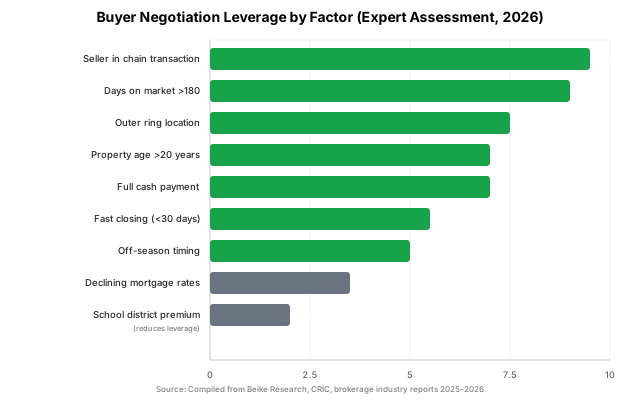
Beyond the listing data, look for the chain transaction pattern — what the industry calls 连环单. An estimated 50–60% of Shanghai second-hand sellers are simultaneously buyers, meaning they have already signed (or plan to sign) a purchase contract on another property with its own deadline (industry consensus from Lianjia and Centaline, 2024–2025). If your seller is in this position, they face a hard constraint: they need to close their sale to fund their purchase, and a breach on their downstream deal can trigger penalty clauses. This is the strongest leverage point in Shanghai's second-hand market.
How do you identify a chain-transaction seller? Ask directly through your agent: "房东是不是也是置换?" (Is the landlord also upgrading?). A motivated agent will probe for you. Indicators include: the landlord who is flexible on closing date, the one who asks about your timeline, the one who has already moved out or is renting elsewhere. Each of these signals a seller who needs to close, not one who is testing the market.
Comparable transactions are your other essential input. Pull the last three months of closed transactions in the same building or within 500 meters on Beike's transaction map. These are real closing prices — not asking prices — and they anchor your offer in data rather than emotion. If the unit you want is listed at CNY65,000/m² but recent comps closed at CNY58,000–60,000/m², you have a factual basis for an offer the landlord cannot dismiss as lowball.
In 2025, Shanghai's average second-hand listing spent 90–120 days on market (Beike Research Institute, 2025), with luxury segments above CNY15 million taking six months or longer. Combined with the fact that 50–60% of sellers are chain-transaction buyers with their own deadlines, the data gives motivated buyers a clear information advantage — if they do the research.
How Do You Build a Data-Backed Offer?
As of 2025, Shanghai's city-wide average negotiation room — the gap between listing price and final transaction price — ran roughly 5–8%, with district-tier variation ranging from 3–5% in the inner ring to 15–20%+ in far suburbs (CRIC + Beike Research Institute, 2025). That range is your data-backed starting point. The mistake most first-time buyers make is anchoring to the listing price. Your anchor should be the comparable transactions, adjusted for floor level, renovation, renovation quality, and orientation.
Here is the framework. First, establish the market value from comps: the weighted average of the last three months of closed transactions for comparable units within 500 meters. Second, adjust for your specific unit's attributes — a high-floor, south-facing, recently renovated unit commands a premium; a low-floor, north-facing, dated unit warrants a discount. Third, apply the district-tier negotiation margin. For a middle-ring unit with a comp-based value of CNY5.5 million, a 7–8% negotiation discount puts your opening offer at CNY5.05–5.12 million. That is not aggressive; it is data-supported.
The psychology matters too. An offer that is 8–10% below asking in a market where 72% of sellers already price within 5% of market valuation (Beike Big Data, 2025) signals seriousness — you have done your homework, you know the comps, and you have a walk-away number. Landlords and their agents recognize the difference between an uninformed lowball and a data-anchored offer. The former gets rejected; the latter opens a negotiation.
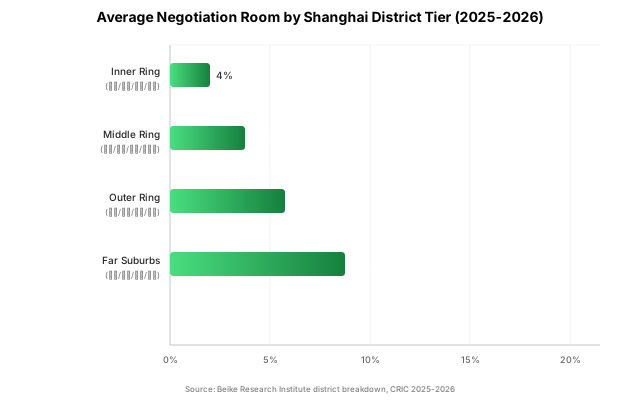
In 2025–2026, Shanghai's average negotiation room runs 5–8% city-wide (CRIC + Beike Research Institute, 2025), with district-tier variation from 3–5% in the inner ring to 15–20%+ in far suburbs. First-time buyers targeting middle and outer ring districts can open at 8–10% below asking with data to support it.
One more variable strengthens your offer: payment terms. In a market where bank valuations for second-hand homes frequently come in below contract price — forcing buyers to increase their down payment — offering a shorter closing timeline or a larger initial payment reduces the landlord's risk. If you can close within 30–45 days, say so explicitly. Speed is a form of value, and many landlords discount for it.
What Negotiation Tactics Work with Shanghai Landlords?
In 2025, Shanghai's second-hand market saw average closing timelines of 90–120 days from listing to contract, with negotiated deals frequently compressing to 30–60 days once both parties were at the table (Beike Research Institute, 2025). The negotiation itself is usually shorter than people expect — but the preparation that precedes it determines the outcome.
Timing your offer. Shanghai has two seasonal lulls: the January–February Spring Festival window and the July–August summer slowdown. Sellers who list during these periods are frequently motivated — they want to close before the holiday or before the school-year calendar locks in their own purchase. Policy announcement windows also create urgency: when the PBOC cuts LPR or the municipal government adjusts purchase restrictions, sellers who have been sitting on the fence often reprice or become more flexible, expecting (usually incorrectly) that stimulus will bring competing buyers back.
The inspection as leverage. Every second-hand unit has defects — aging pipes, worn floors, outdated electrical, water stains on the ceiling. A professional home inspection (typically CNY500–2,000) gives you a documented list of issues that becomes a negotiation tool. Do not use it to nickel-and-dime; use it to justify a meaningful price adjustment. "The inspection found CNY40,000 in necessary electrical and plumbing work; we have adjusted our offer accordingly" is a data-anchored argument that is hard for a landlord to dismiss.
The agent dynamic. Your agent (zhongjie) works for the seller by default — the seller pays the commission. This does not mean your agent is your enemy, but it means you should not assume they will push the seller to accept your best offer. A skilled buyer's agent adds value by surfacing comps the seller's agent won't volunteer, by reading the seller's motivation signals, and by framing your offer in terms the seller finds acceptable. If your agent only shows you units and forwards offers, you need a better agent.
Competing offers: real and manufactured. In a 2026 buyer's market, genuine competing offers are less common than sellers claim. When a landlord says "another buyer is offering full price," ask for specifics through your agent — and watch how quickly the "other buyer" materializes or evaporates. In a market with 180,000+ active listings, you can almost always find a comparable unit. The willingness to walk is your most powerful tactic, and it only works if you mean it.

In 2025, roughly 72% of Shanghai second-hand sellers priced within 5% of market valuation (Beike Big Data, 2025), which means most listing prices are already realistic — but realistic is not the same as non-negotiable. The 5–8% city-wide negotiation room exists because carrying costs, chain-transaction deadlines, and simple market friction give prepared buyers a structural edge.
How Do You Close Without Overpaying?
In 2025, Shanghai's average listing-to-transaction price ratio sat at roughly 94.5% (Beike Research Institute, 2025), meaning the typical negotiated outcome landed 5.5% below the asking price. Your goal is to meet or beat that average — and in the current market, you can.
The final stage of negotiation is a test of resolve. After your opening offer and the landlord's counter, there is usually one or two rounds of convergence. The pattern that works: open 8–10% below asking (data-anchored to comps), accept a first concession that moves you halfway to your target, then hold firm. Each concession you make should be smaller than the last — CNY100,000, then CNY50,000, then CNY20,000. The shrinking concessions signal that you are approaching your ceiling, and experienced sellers recognize the pattern.
Set your walk-away number before you enter the negotiation. This is the maximum you will pay, calculated from comps, your mortgage capacity, and a margin of safety for post-purchase costs (renovation, furniture, transaction taxes). If the landlord will not come down to your walk-away number, walk. In a market with 180,000+ listings and an absorption cycle of 9–11 months, there is always another unit. The discipline to walk away is not a tactic — it is the foundation that makes every other tactic work.
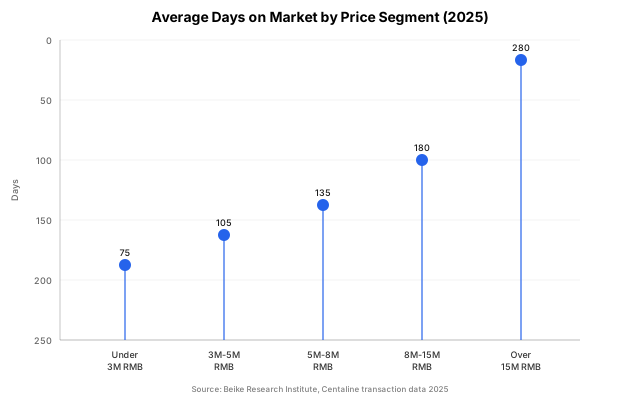
In 2025, Shanghai listings above CNY15 million averaged over 280 days on market (Beike Research Institute, 2025). The longer a unit sits, the more leverage shifts to the buyer — and the more likely the landlord is to accept a data-backed offer below asking.
Common Mistakes to Avoid
Negotiating in Shanghai's second-hand market is as much about avoiding errors as it is about executing tactics. These are the mistakes that cost first-time buyers the most money.
Anchoring to the listing price. The asking price is the seller's aspiration, not market value. Your reference point should be comparable closed transactions — the Beike transaction map, not the Beike listing page. Every offer you make should be justified in comps, not in the landlord's sticker price.
Ignoring days on market. A unit listed for 30 days and a unit listed for 210 days are fundamentally different negotiations, even if they are in the same building. The listing duration is public information. Use it.
Emotional bidding. You will fall in love with an apartment. You will picture your furniture in the living room. And you will be tempted to raise your offer to "make sure I get it." In a market with 180,000+ alternatives, love is a liability. Fall in love after you have a signed contract.
Skipping the inspection. A CNY1,500 home inspection that uncovers CNY40,000 in deferred maintenance pays for itself 25-fold and gives you a factual basis for a price adjustment. Skipping it to save money is false economy.
Missing the chain-transaction signal. If the landlord is upgrading and has a deadline on their own purchase, you have leverage most buyers never ask about. The question "您是不是也是置换?" takes five seconds to ask and can save you six figures.
Misreading the agent's incentive. Your agent works for you only if you make them work for you. If your agent discourages negotiation, refuses to present data-backed offers, or pushes you to close at asking, find a different agent. In a buyer's market, a good agent is a negotiator — not a messenger.
Frequently Asked Questions
What's a reasonable discount to ask for in Shanghai?
City-wide, the average negotiation room ran 5–8% in 2025 (CRIC + Beike Research Institute). In middle and outer ring districts, opening at 8–10% below asking is data-supported. Inner-ring units with school-district premiums leave less room — 3–5% is more realistic. Anchor your offer to comparable closed transactions, not the listing price.
How long should I expect negotiation to take?
Most negotiated deals close within 30–60 days of the first serious offer (Beike Research Institute, 2025). The full cycle from listing to contract averages 90–120 days. If a landlord is in a chain transaction with a downstream deadline, the timeline can compress to two weeks — which is exactly when your leverage peaks.
Does the agent work for me or the landlord?
In Shanghai's second-hand market, the seller typically pays the agent's commission, so the listing agent works for the seller. If you are using a buyer's agent, clarify upfront that they will negotiate on your behalf, surface unfavorable comps, and push back on the seller's asking price. An agent who only shows units and forwards offers is not earning their fee.
Should I negotiate before or after the inspection?
Make your initial offer before the inspection, but build in an inspection contingency. Use the inspection findings to justify a price adjustment or credit at closing. In Shanghai, professional home inspections cost CNY500–2,000 and routinely uncover CNY20,000–80,000 in issues — a strong return on a small investment.
How do I tell if the landlord is in a chain transaction (连环单)?
Ask your agent to probe directly: "房东是不是也是置换?" Indicators include flexibility on closing date, the landlord already living elsewhere, or urgency to close within a specific timeframe. With an estimated 50–60% of Shanghai sellers also being buyers (Lianjia/Centaline consensus, 2024–2025), the odds are good — and a chain-transaction seller with a deadline is your strongest negotiation scenario.
What if the landlord won't budge?
Walk away. With 180,000+ active listings in Shanghai (CRIC, 2025 Q4), there is almost always a comparable unit. The willingness to walk is what makes your other offers credible. In a buyer's market, the buyer who can walk away holds the real power.
Conclusion
Shanghai's second-hand market in 2026 offers first-time buyers a structural negotiating advantage that did not exist five years ago: 180,000+ active listings, prices roughly 20% below peak, and a market where the majority of sellers are themselves buyers with deadlines. The leverage is real — but only if you use data instead of emotion.
Run your comparable transactions before you visit a unit. Check the listing duration and price-change history. Ask whether the landlord is in a chain transaction. Open with an offer 8–10% below asking, anchored to comps. Hold your walk-away number. And remember: in a market this deep, the best negotiation tactic is always the willingness to find another apartment.
Sources
- Beike Research Institute (贝壳研究院), Shanghai second-hand market annual report and big data analytics, 2025–2026, https://www.ke.com
- CRIC (克而瑞), Shanghai residential transaction monthly reports and annual outlook, 2025–2026, https://www.cric.com
- National Bureau of Statistics (国家统计局), 70-City Price Index, 2025–2026, https://www.stats.gov.cn
- Centaline (中原地产), Shanghai second-hand transaction and negotiation data, 2024–2025, https://www.centaline.com.cn
- Lianjia (链家), chain transaction (连环单) prevalence estimates and industry analysis, 2024–2025, https://www.lianjia.com
- East Money (东方财富), Shanghai housing transaction volume and market commentary, 2025, https://www.eastmoney.com