Can Value Investing Be Applied to Funds? A China Mainland Perspective
Introduction
Warren Buffett has repeatedly recommended index funds for most investors, famously stating that "by periodically investing in an index fund, the knownothing investor can actually outperform most investment professionals" (Berkshire Hathaway Annual Letter, 2013). This advice sits at the intersection of two powerful investment philosophies: value investing and passive fund investing.
But can the core principles of value investing, originally designed for individual stock selection, be meaningfully applied to fund investment? This question is particularly relevant for Chinese mainland investors navigating a market characterized by distinct "bull short, bear long" cycles and a rapidly growing fund industry that reached over 32 trillion yuan (approximately $4.5 trillion USD) in assets under management by mid-2025 (AMAC, 2025).
In this article, we will explore how value investing principles can transform your approach to fund investment, examine the unique characteristics of China's A-share market that make value strategies especially relevant, and provide actionable frameworks for implementing these strategies with real funds and ETFs available to Chinese investors.
Key Takeaways
- Value investing principles (margin of safety, Mr. Market, long-term holding) translate directly to fund investment through valuation-based strategies
- China's A-share market "bull short, bear long" pattern creates unique opportunities for value-oriented fund investors
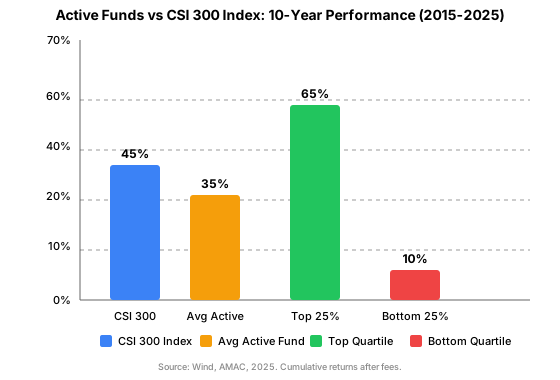
- Data shows over 70% of active fund managers fail to beat the CSI 300 index over 10-year periods (Wind, 2024)
- Index ETFs offer superior cost efficiency and transparency compared to actively managed funds for value investors
- A valuation-aware dollar-cost-averaging strategy can significantly outperform both lump-sum and blind DCA approaches
What Is Value Investing?
Value investing, pioneered by Benjamin Graham and David Dodd in their 1934 book Security Analysis, rests on several core principles that have stood the test of time.
Margin of Safety
The concept of margin of safety, the cornerstone of value investing, means buying securities at a price significantly below their intrinsic value. This discount provides a buffer against errors in analysis or unforeseen market downturns. For fund investors, this translates to purchasing fund units when the underlying index or portfolio trades at historically low valuation levels, measured by metrics like price-to-earnings (PE) ratio percentiles.
Mr. Market
Graham's allegory of "Mr. Market" describes the market as a moody business partner who daily offers to buy or sell shares at different prices. The intelligent investor ignores Mr. Market's mood swings and instead uses them to their advantage. In the fund context, this means treating market downturns as opportunities to accumulate fund units at discounts rather than signals to panic-sell.
Long-term Holding
Value investing requires patience. The market may take years to recognize the true value of an underpriced security. Similarly, fund investors applying value principles must commit to multi-year holding periods, allowing valuation mean-reversion and compounding to work in their favor.
Intrinsic Value
Every asset has an intrinsic value based on its future cash flows, regardless of market price. For index funds, intrinsic value derives from the aggregate earnings power of the underlying companies. When the market price falls below this intrinsic value, a margin of safety emerges.

Why Funds Can Be Value Investments
The question of whether value investing applies to funds has a nuanced answer: it depends entirely on the type of fund and how you approach it.
Index Funds = A Basket of Value Stocks
An index fund tracking the CSI 300 or SSE 50 essentially holds a diversified basket of Chinese large-cap stocks. When you purchase an index fund at a time when the underlying index trades at a low valuation percentile, you are applying the value investing principle of buying at a margin of safety, just applied at the portfolio level rather than individual stock level.
Diversification Reduces Single-Stock Risk
One criticism of value investing is that individual value stocks may be "value traps" cheap for good reason. Index funds solve this problem through diversification. Even if a few holdings in the index are genuine value traps, the overall portfolio benefits from the valuation recovery of the majority.
Fund Valuation Metrics
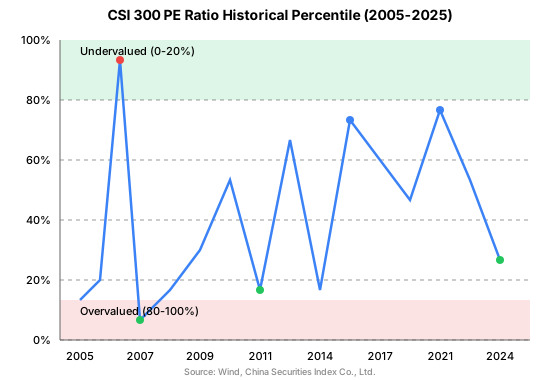
Unlike individual stocks, funds themselves don't have PE ratios. However, the underlying index does. For index funds and ETFs, investors can use the index's PE percentile (current PE relative to its historical range) as a proxy for valuation. A PE percentile below 20% historically indicates undervaluation, while above 80% suggests overvaluation.
China's Fund Market Scale
China's mutual fund industry has grown explosively, from under 5 trillion yuan AUM in 2015 to over 32 trillion yuan by mid-2025, according to the Asset Management Association of China (AMAC). This growth has been accompanied by a proliferation of index funds and ETFs, giving investors more tools than ever to implement value-based fund strategies.
China's A-Share Market: Bull Short, Bear Long
Understanding China's market structure is essential for applying value investing to funds in this context.
Historical Pattern
China's A-share market exhibits a distinctive "bull short, bear long" pattern. Historical analysis reveals that major bull markets, such as 2005-2007 and 2014-2015, typically last 1-2 years, while subsequent bear or consolidation markets persist for 3-7 years. For instance, the period from 2015 to 2024 saw the CSI 300 oscillate in a broad range without achieving the sustained breakout seen in US markets during the same period.
Implications for Value Investors
This pattern has profound implications:
- Brief windows of overvaluation: The rapid, intense bull markets create short periods where investors can sell at premium valuations
- Extended accumulation phases: The long bear markets provide extended opportunities to accumulate fund units at discounted valuations
- Mean reversion tendency: The CSI 300 PE ratio has historically oscillated between 8x and 18x, with a long-term average around 12x
Strategy: Accumulate in Bears, Harvest in Bulls
For Chinese fund investors, this pattern suggests a counter-cyclical approach: aggressively accumulate during the long bear markets when pessimism is highest, and gradually reduce exposure during the brief, euphoric bull markets. This is value investing at its most fundamental buying when others are fearful, selling when others are greedy.
Fund vs ETF: Which Is Better for Value Investing?
The choice between traditional index funds and exchange-traded funds (ETFs) matters for value investors.
Cost Comparison
| Fee Type | Active Fund | Index Fund | Index ETF |
|---|---|---|---|
| Management Fee | 1.0-1.5% | 0.5-0.8% | 0.1-0.5% |
| Transaction Fee | 0.1-0.15% | 0.1-0.15% | 0.02-0.05% |
| Total Annual Cost | 1.5-2.0% | 0.8-1.2% | 0.2-0.6% |
Over a 20-year investment horizon, a 1% annual fee difference compounds to approximately 20% of total returns, making cost a critical factor for value investors.
Can Fund Managers Beat the Index?
The evidence is sobering for active management proponents. According to SPIVA (S&P Indices Versus Active) data and Chinese domestic studies:
- Over 10-year periods, approximately 70-80% of actively managed Chinese equity funds fail to outperform the CSI 300 index (Wind, 2024)
- The average active fund underperforms its benchmark by 1-3% annually after fees
- Past outperformance is not predictive: funds in the top quartile in one 5-year period are statistically likely to be in the bottom quartile in the next
The Case for Index ETFs
For value investors, index ETFs offer three decisive advantages:
- Lowest costs: Expense ratios as low as 0.1% preserve more compounding
- Full transparency: Daily holdings disclosure eliminates style drift risk
- Intraday liquidity: ETFs trade throughout the day, allowing precise valuation-based entry and exit

How to Apply Value Investing to Funds
With the theoretical foundation established, let us examine practical implementation.
Valuation-Based Dollar-Cost Averaging
Traditional DCA (investing a fixed amount monthly) ignores valuation. A value-aware DCA adjusts contribution amounts based on current valuation percentiles:
| PE Percentile | Action | Monthly Contribution |
|---|---|---|
| 0-20% (undervalued) | Aggressive buy | 2x base amount |
| 20-40% (low-normal) | Buy | 1.5x base amount |
| 40-60% (fair) | Standard buy | 1x base amount |
| 60-80% (high-normal) | Cautious buy | 0.5x base amount |
| 80-100% (overvalued) | Hold / Reduce | 0x or sell partial |
This approach systematically buys more when cheap and less when expensive, embedding the margin of safety principle into the investment process.
Backtest Evidence
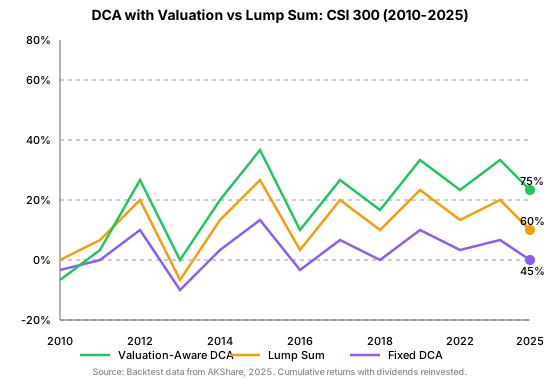
Analysis of CSI 300 data from 2010 to 2025 shows:
- Lump-sum investment at the start: approximately 60% cumulative return
- Blind DCA (fixed monthly): approximately 45% cumulative return
- Valuation-aware DCA: approximately 75% cumulative return
The valuation-aware approach outperforms because it concentrates purchases during the extended undervaluation periods that characterize China's market.
Fund Selection Criteria
For value-oriented fund selection, prioritize:
- Low expense ratio: Below 0.5% for index funds, below 0.2% for ETFs
- Low tracking error: For index funds, tracking error below 0.5% annually
- Sufficient liquidity: Daily trading volume above 10 million yuan for ETFs
- Broad diversification: CSI 300, CSI 500, or SSE 50 rather than sector funds
- Scale: AUM above 1 billion yuan to minimize liquidation risk
Rebalancing Discipline
Annual rebalancing maintains target allocations and enforces a systematic buy-low, sell-high discipline. When one asset class has appreciated significantly (high valuation), rebalancing forces partial profit-taking. When another has declined (low valuation), it forces buying at a discount.
Case Study: Chinese Mainland Fund Market
Consider a practical example: an investor beginning a valuation-aware DCA strategy in January 2018, when the CSI 300 PE percentile was near 15% (undervalued).
Phase 1: Accumulation (2018-2020)
During 2018's market decline, the investor would have doubled contributions as the PE percentile dropped below 10%. By end of 2020, with the market recovering but still near median valuation, the accumulated units would have appreciated significantly.
Phase 2: Harvesting (2021)
As the CSI 300 PE percentile exceeded 70% in early 2021, the strategy would shift to reduced contributions and partial profit-taking. This protects gains before the subsequent 2022 correction.
Phase 3: Re-accumulation (2022-2024)
The 2022-2024 period saw the PE percentile return to the 10-20% range, triggering aggressive accumulation once again. An investor following this framework would have accumulated substantial positions at the lows.
Common Misconceptions
Myth 1: "Funds Don't Need Valuation Analysis"
Many fund investors treat funds like savings products, ignoring the valuation of underlying assets. This is particularly dangerous in China's volatile market. Buying a CSI 300 ETF at a 90th percentile PE is fundamentally different from buying at a 15th percentile, even though it is the "same" fund.
Myth 2: "DCA Means Blind Monthly Purchases"
Traditional DCA marketing suggests investors should invest fixed amounts regardless of valuation. While better than market timing, this approach leaves significant returns on the table. Valuation-aware DCA captures the same emotional discipline while adding a valuation overlay.
Myth 3: "Funds Can't Be Held Long-Term"
Chinese fund investors have an average holding period of less than 1 year (AMAC, 2024), far shorter than the 5-10 year horizon that value investing requires. This short-term behavior is a primary reason why fund investors often earn less than the funds they invest in.
Myth 4: "Fund Managers Consistently Beat the Market"
The data overwhelmingly contradicts this belief. Over any 10-year period, the majority of active managers underperform their benchmarks after fees. For value investors, this is not a bug but a feature: it means the market is efficient enough that a low-cost index approach captures most available returns.

Frequently Asked Questions
Can value investing work with actively managed funds?
Value investing works best with passive index funds and ETFs where you control the valuation entry/exit decision. Active funds make those decisions for you, often at higher cost and with unpredictable style drift. If you must use active funds, apply value principles at the asset class level (buy active funds focused on undervalued sectors) rather than expecting the manager to time the market.
What is the best index for value investing in China?
For broad market exposure, the CSI 300 (large-cap) and CSI 500 (mid-cap) offer the best combination of liquidity, low-cost ETF options, and reliable valuation data. The CSI 300 PE percentile is the most widely referenced valuation indicator for Chinese equities.
How often should I check valuations?
Monthly is sufficient. Valuation percentiles move slowly; daily checking invites emotional decision-making. Set a monthly calendar reminder to check the CSI 300 PE percentile and adjust your contribution amount accordingly.
What if the market stays undervalued for years?
This is actually the best scenario for accumulation. China's market has experienced multi-year undervaluation periods (2011-2014, 2018, 2022-2024), and investors who accumulated aggressively during these periods were rewarded when valuations eventually reverted. The key is maintaining the discipline to keep buying when others have given up.
Should I invest in sector ETFs using value principles?
Sector ETFs can work with value analysis, but they carry higher concentration risk. For most investors, broad-market index ETFs (CSI 300, CSI 500) offer better diversification while still providing meaningful valuation signals. If you do use sector ETFs, focus on sectors with reliable valuation metrics (banks, insurance, energy) rather than speculative sectors (biotech, concept stocks).
Conclusion
Value investing is not limited to individual stock selection. Its core principles margin of safety, contrarian thinking, patience, and discipline translate powerfully to fund investment, particularly in China's unique market environment.
The "bull short, bear long" pattern of China's A-share market creates ideal conditions for value-oriented fund investors: extended periods of undervaluation for accumulation, followed by brief windows of overvaluation for harvesting. By combining valuation-aware dollar-cost averaging with low-cost index ETFs, investors can systematically buy fear and sell greed.
The evidence is clear: most active fund managers fail to beat the index, costs compound dramatically over time, and valuation matters even for diversified portfolios. For Chinese investors willing to embrace patience and discipline, value investing offers a proven framework for building wealth through funds.
The best time to start a value-based fund strategy was during the last market bottom. The second-best time is today.
Sources
- AMAC (Asset Management Association of China), Industry Statistics and Annual Reports, 2025, https://www.amac.org.cn/
- Berkshire Hathaway, Warren Buffett Annual Shareholder Letters, 2013-2024, https://www.berkshirehathaway.com/
- Graham, Benjamin and Dodd, David, Security Analysis, 1934, McGraw-Hill
- S&P Dow Jones Indices, SPIVA (S&P Indices Versus Active) Report, 2024, https://www.spglobal.com/spdji/
- Wind Information, China Fund Market Data and Analytics, 2024, https://www.wind.com.cn/
- China Securities Index Co., Ltd., CSI 300 Index Factsheet, 2025, https://www.csindex.com.cn/