Why Are D&D-Like RPG Stories So Dramatic and Captivating? The Narrative Design Behind the Genre's Best Games
Why Are D&D-Like RPG Stories So Dramatic and Captivating? The Narrative Design Behind the Genre's Best Games
In 2025, Larian Studios confirmed that Baldur's Gate 3 had sold more than 20 million copies worldwide — a number that would make any film studio or novelist envious (Larian Studios, 2025). That figure isn't an isolated hit. The global role-playing game market reached roughly 30 billion in 2024 and is projected to grow at 8–12% annually through 2030 (Grand View Research, 2024). These aren't niche numbers. They point to a simple truth: something about the way D&D-derived RPGs tell stories hits harder than almost anything else in entertainment. This article breaks down exactly why — using Planescape: Torment, the Baldur's Gate trilogy, Pathfinder: Wrath of the Righteous, and Pillars of Eternity as the case studies.
Key Takeaways
- Baldur's Gate 3 peaked at 875,343 concurrent players on Steam — the highest ever for a single-player RPG (SteamCharts, 2023).
- D&D-like stories captivate because they fuse player agency, consequential choice, and reactive companions into a single system no passive medium can replicate.
- Planescape: Torment proved 25 years ago that an RPG could ask philosophical questions blockbusters still won't touch.
- The RPG market hit 30 billion in 2024, showing narrative-driven games aren't a niche — they're the growth engine (Grand View Research, 2024).
Why Does Player Agency Make RPG Stories Feel More Intense?
When you watch a film, the hero makes the bold choice. When you play a D&D-like RPG, you make it — and you live with what comes after. That shift from spectator to participant is the single biggest reason these stories feel so dramatic. In 2023, Baldur's Gate 3 shipped with more than 170 distinct ending variations across roughly 288 quests, all shaped by decisions the player made hours or dozens of hours earlier (Larian Studios, 2023). No scripted narrative can match the tension of knowing that your specific combination of choices produced this exact outcome.
Agency works because it hijacks a psychological principle researchers call narrative transportation — the feeling of being absorbed into a story. Studies in media psychology show that when audiences believe their actions shape the outcome, emotional investment rises sharply compared to passive consumption (Green & Brock, Journal of Personality and Social Psychology, 2000). D&D-derived games didn't need the research to prove it. Tabletop Dungeons & Dragons has relied on this mechanic since 1974: the dice are yours, the character is yours, the consequences are yours. Video-game RPGs inherited that contract directly.

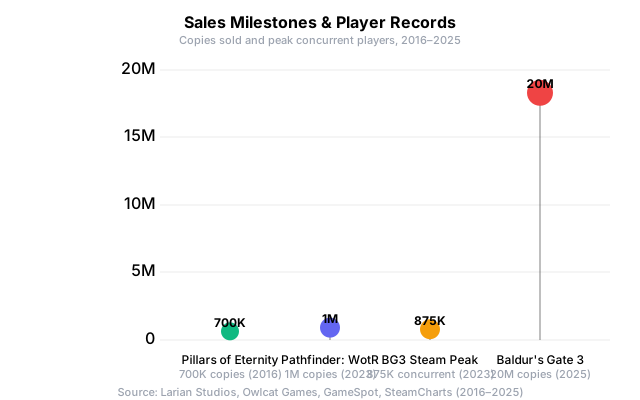
Baldur's Gate 3 pushed this further than any predecessor. At launch it peaked at 875,343 concurrent players on Steam (SteamCharts, 2023) — a record for a single-player RPG, and a number fueled not by combat depth alone but by the promise that the story would bend around you. Players weren't logging in to see Larian's story. They were logging in to live their own.
How Do Consequential Choices Create Real Emotional Stakes?
Drama requires stakes, and stakes require that something genuinely be at risk. In D&D-like RPGs, the design philosophy is simple: choices must have weight that persists. This is the mechanic that separates a memorable RPG from a forgettable one, and it's the through-line connecting every game on this list.
Pathfinder: Wrath of the Righteous is perhaps the purest modern example. Released by Owlcat Games in 2021, it sold 100,000 copies on Steam within its first 24 hours and surpassed one million copies across all platforms by early 2023 (Owlcat Games, 2023). Its central design gambit is the Mythic Path system: early in the story you commit to an angelic, demonic, lich, swarm, or legendary trajectory, and that single decision rewrites large portions of the remaining narrative, your companions' fates, and the ending. The game doesn't just tell you power has a cost. It makes you pay it, hundreds of hours later, when a companion you love judges you for a deal you made in Act One.
Citation capsule: Pathfinder: Wrath of the Righteous sold over 100,000 copies on Steam within 24 hours of launch and surpassed one million copies across all platforms by early 2023 (Owlcat Games, 2023). Its Mythic Path system — where one early choice rewrites the entire back half of the story — is the clearest modern example of consequential choice as drama engine.
Pillars of Eternity uses a different but equally potent tool: a reputation system that tracks not just whether you were "good" or "evil" but how you were good or evil, and with which factions. Obsidian Entertainment's 2015 crowdfunded RPG sold over 500,000 copies by 2016 (GameSpot, 2016), remarkable for a brand-new intellectual property built on a classic-ruleset sensibility. In Pillars, you can resolve a crisis through diplomacy, deception, violence, or religious appeal — and the game remembers which method you favored. NPCs react differently. Quests close or open. The world reshapes itself around your accumulated choices. That's not a branching script. That's a living consequence engine.
The emotional result is the same every time: you can't blame the writer. When a beloved character dies in Baldur's Gate 2 because you trusted the wrong informant, the only person responsible is the one holding the mouse. That's a level of dramatic accountability no novel or film can impose, and it's why these stories linger in memory for decades.
Why Are RPG Companions So Unforgettable?
If agency is the skeleton and consequence is the muscle, companions are the heart. The D&D tradition of adventuring parties — each member with their own history, flaw, and agenda — gives RPGs an emotional range that single-protagonist stories struggle to achieve.
Baldur's Gate 1 and 2, developed by BioWare and released in 1998 and 2000, established the template. Each companion had a personal quest, an approval rating, and opinions about your other companions. Jaheira's grief over Khalid, Minsc's hamster, Edwin's arrogance — these weren't side content. They were the reason players replayed. The approval system meant that how you behaved toward one character could fracture or cement a relationship with another, creating a web of interpersonal drama that emerged naturally from play rather than from cutscenes.
Baldur's Gate 3 inherited and massively expanded this philosophy. It launched with 10 fully voiced companions, 13 romance options, and approximately 1.3 million lines of dialogue across 140 hours of cutscenes (Larian Studios, 2023). Every companion reacts to your mythic-level decisions, your moral compromises, and your treatment of NPCs they care about. The result is a party that feels less like a squad of game assets and more like a group of people who genuinely know you — and who will leave, betray, or die for you based on that knowledge.

The captivation here is structural, not accidental. Because you recruit these characters, travel with them for dozens of hours, and make choices that affect them personally, you form earned attachments. The drama isn't manufactured by a writer in a room. It's co-created between the player and the game. That's a fundamentally different emotional transaction than watching a scripted friendship on screen.
What Made Planescape: Torment's Story Decades Ahead of Its Time?
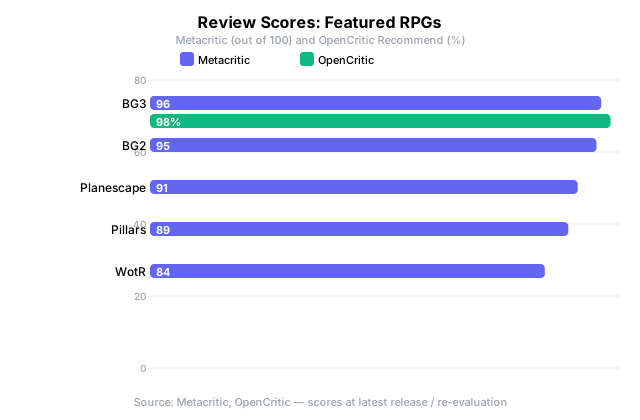
Every game on this list is dramatic. But only one is routinely cited — 25 years after release — as proof that games can be philosophy. Planescape: Torment, released by Black Isle Studios in 1999, holds a 91 Metacritic score (Metacritic, 1999) and has topped "greatest RPG of all time" lists from PC Gamer, IGN, and Rock Paper Shotgun across multiple decades. Its central question — "What can change the nature of a man?" — is not a gameplay mechanic. It's a genuine philosophical inquiry, and the entire game is structured as an argument about the answer.
The Nameless One, the protagonist, is an amnesiac immortal who has lived countless lives and forgotten them all. The story asks whether identity is defined by memory, by action, or by something more fundamental — and it refuses to give a clean answer. Every major character embodies a different thesis: the practical Ravel, the loyal Morte, the idealistic Annah. By the end, the player has not just watched a meditation on identity. They have conducted one, through the accumulated weight of their own choices.
This is what separates D&D-derived storytelling from most blockbuster narratives. Blockbusters ask whether the hero will save the world. Planescape: Torment asks whether the hero deserves to exist. Pillars of Eternity, made by many of the same people, inherited that willingness to ask uncomfortable questions — its plot revolves around souls, reincarnation, and the ethics of godhood in a way that treats the player as an adult capable of moral ambiguity.
The captivation here comes from respect for the player's intelligence. These games trust that you want to think, not just react. That trust creates a deeper engagement than spectacle alone ever could.
How Does Systemic Storytelling Generate Drama No Script Could Plan?
There's a fourth ingredient in the captivation formula, and it's the one most critics miss: emergence. D&D-derived RPGs are built on systems — rules, stats, dice, faction reputations — and those systems interact to produce stories the writers never explicitly scripted.
Baldur's Gate 3 is the apex example. With 288 quests, 12 classes, 11 species, and a physics-driven interaction model, players routinely discover solutions the developers never anticipated. Streamers have solved major encounters by shoving villains off cliffs, turning into mice, or recruiting supposed enemies. Every unexpected solution is a personal story — and personal stories are inherently more dramatic than prescribed ones, because the player authored them under pressure.
This is the tabletop DNA showing through. In a D&D session, the Game Master presents a scenario and the players respond with creativity no designer could fully predict. The best video-game RPGs preserve that improvisational space. Pathfinder: Wrath of the Righteous, built directly on Paizo's tabletop ruleset, leans into mechanical depth precisely so that systemic storytelling can emerge. Pillars of Eternity's stronghold and reputation systems generate incidental narratives — a village saved here becomes an army recruited there — that no cutscene could replicate with the same emotional authenticity.
Citation capsule: Baldur's Gate 3 shipped with approximately 1.3 million lines of dialogue, 140 hours of cutscenes, and 170+ ending variations across 288 quests (Larian Studios, 2023). The scale isn't the point — the point is that systemic depth lets players generate personal, emergent stories no script could pre-author.
The drama, in other words, is partly self-made. And self-made drama is the most captivating kind, because it belongs to the audience in a way no other medium permits.
Why Are These Games Dominating Sales Charts Right Now?
The market data closes the loop between design theory and audience behavior. The global RPG market reached an estimated 30 billion in 2024 and is projected to grow at a compound annual rate of 8–12% through 2030 (Grand View Research, 2024). Baldur's Gate 3 alone sold 20 million copies by the end of 2025 (Larian Studios, 2025). Pathfinder: Wrath of the Righteous crossed one million. Pillars of Eternity crossed half a million. These aren't anomalies. They're the predictable result of a storytelling model that treats players as co-authors rather than consumers.
The audience is voting with its wallets, and it's voting for stories it can inhabit. Passive entertainment — films, series, novels — will always have a place. But it cannot offer the one thing D&D-derived RPGs do: the feeling that the drama happened because of you, to you, and could have gone differently if you'd chosen otherwise. That feeling is addictive, and it explains why a 25-year-old game about an amnesiac immortal still shows up on "best stories ever told" lists alongside works that cost a hundred times more to produce.
Frequently Asked Questions
Why do D&D-based games tell better stories than most other video games?
Because the tabletop roots give them a design philosophy built on player agency, consequential choice, and systemic emergence — three ingredients most genres treat as optional. Baldur's Gate 3's 170+ endings and 875,343-peak concurrent player record (SteamCharts, 2023) prove that audiences reward games that treat them as co-authors rather than spectators.
Is Planescape: Torment still worth playing today?
Yes. Its 91 Metacritic score (1999) and decades of "greatest RPG" rankings reflect a story that aged better than most modern blockbusters. The Enhanced Edition runs on current systems, and its central question — "What can change the nature of a man?" — remains one of the most ambitious narratives in any medium.
What makes Pathfinder: Wrath of the Righteous different from Baldur's Gate 3?
Different emphasis. BG3 prioritizes reactivity and player freedom; WotR prioritizes mechanical depth and the long-term consequences of its Mythic Path system. WotR sold over one million copies by 2023 (Owlcat Games, 2023) by leaning into the tabletop ruleset's complexity rather than smoothing it away.
Why did Pillars of Eternity succeed as a new IP?
It proved there was a hungry audience for classic-style, narrative-dense RPGs. Its 2012 Kickstarter raised $3,986,929 from 73,986 backers (Kickstarter, 2012), and the game sold over 500,000 copies by 2016 (GameSpot, 2016). Crowdfunding let Obsidian build the game fans wanted without a publisher diluting the vision.
Will AI make RPG stories even more captivating?
Potentially — but the core appeal isn't content volume, it's authorship. Players are captivated because their choices matter. AI that generates reactive, consequential narrative in real time could deepen that feeling, but only if it preserves the sense that the player is driving the story, not watching an AI perform it.
Conclusion
D&D-like RPG stories captivate because they solve a problem passive media can never fully solve: how to make the audience the author. Agency turns spectators into participants. Consequence turns choices into drama. Companions turn mechanics into relationships. And systemic design turns scripted moments into personal legends. Planescape: Torment asked what a man is. Baldur's Gate asked who your friends are. Pathfinder asked what you'd sacrifice for power. Pillars asked what you owe the dead. These aren't just game plots — they're mirrors, and the player is always standing in front of them.
The numbers confirm the theory. Twenty million copies of Baldur's Gate 3. A 30 billion genre. An 875,343-person crowd logging in simultaneously to live a story no one else will live the same way. The most dramatic stories in entertainment aren't the ones with the biggest budgets. They're the ones where you hold the dice.
Sources
- Larian Studios, "Baldur's Gate 3 sales surpass 20 million copies", larian.com, 2025
- Larian Studios, "Baldur's Gate 3 launch statistics — 288 quests, 1.3M lines, 170+ endings", 2023
- SteamCharts, "Baldur's Gate 3 — all-time peak 875,343 concurrent players", steamcharts.com/app/1086940, August 2023
- Grand View Research, "Role Playing Games Market Size, Share & Trends Analysis Report", 2024
- Owlcat Games, "Pathfinder: Wrath of the Righteous surpasses one million copies sold", owlcatgames.com, 2023
- GameSpot, "Pillars of Eternity has sold half a million copies", gamespot.com, 2016
- Kickstarter, "Pillars of Eternity crowdfunding campaign — $3,986,929 from 73,986 backers", 2012
- Metacritic, "Planescape: Torment — PC 91/100", metacritic.com, 1999
- Green, M.C. & Brock, T.C., "The Role of Transportation in the Persuasiveness of Public Narratives", Journal of Personality and Social Psychology, 2000