MAAS vs Tinkerbell vs Ironic: The Ultimate Guide to Bare Metal Orchestration Engine Selection
MAAS vs Tinkerbell vs Ironic: The Ultimate Guide to Bare Metal Orchestration Engine Selection
Choosing a bare metal orchestration engine is one of the most consequential decisions in building an automated infrastructure stack. The engine you select shapes your provisioning workflow, determines which operating systems you can deploy, defines how you integrate with configuration management, and constrains your team's automation possibilities for years. Yet the decision is surprisingly difficult: four open-source options (MAAS, Tinkerbell, Ironic, Foreman) each have passionate communities, different architectural philosophies, and distinct sweet spots.
This guide provides a structured comparison based on ecosystem fit, community maturity, hardware support, and operational complexity. The right answer depends not on which tool is "best" in isolation, but on which aligns with your existing infrastructure, team skills, and scale requirements.
Key Takeaways
- MAAS (499 GitHub stars): Best for Ubuntu-centric environments; turnkey setup with built-in IPAM/DHCP/DNS
- Tinkerbell (989 stars, archived Dec 2025): Kubernetes-native, workflow-driven; best for K8s-centric teams but consider the archive status
- Ironic (564 stars): OpenStack-integrated with the widest hardware driver support and most complete state machine
- Foreman (2,900 stars): Largest community; the only option combining provisioning with Puppet/Salt configuration management
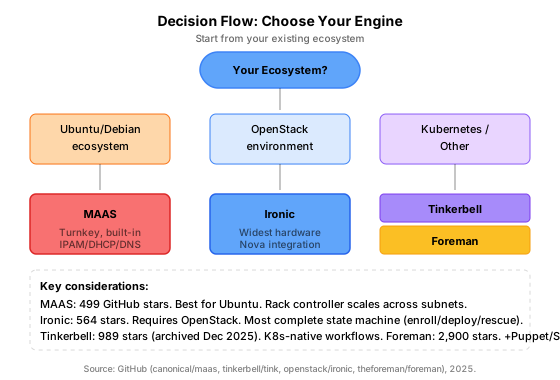
- The choice is determined by your existing ecosystem: Ubuntu shop → MAAS, OpenStack shop → Ironic, K8s-native → Tinkerbell, need CM → Foreman
Quick Comparison Table
| Feature | MAAS | Tinkerbell | Ironic | Foreman |
|---|---|---|---|---|
| GitHub Stars | 499 | 989 | 564 | 2,900 |
| First Release | 2012 | 2019 | 2013 | 2009 |
| Primary Ecosystem | Ubuntu/Canonical | Kubernetes/CNCF | OpenStack | Puppet/Salt/Ansible |
| License | GPLv3 | Apache 2.0 | Apache 2.0 | GPLv3 |
| Built-in IPAM | ✅ Yes | ❌ No | ❌ No (uses Neutron) | ✅ Yes |
| Built-in DHCP/DNS | ✅ Yes | ❌ No | ❌ No | ✅ Yes |
| Config Management | ❌ No | ❌ No | ❌ No | ✅ Puppet/Salt/Chef |
| Web UI | ✅ Full | ❌ Minimal | ❌ Minimal | ✅ Full |
| REST API | ✅ Yes | ✅ Yes | ✅ Yes | ✅ Yes |
| State Machine | Basic | Workflow-driven | Most complete | Moderate |
| Hardware Drivers | Good | Good | Widest | Good |
| Multi-tenancy | ✅ Yes | ✅ Yes | ✅ Yes | ✅ Yes |
| Windows Support | ✅ Yes | ⚠️ Limited | ✅ Yes | ✅ Yes |
| RHEL/CentOS Support | ✅ Yes | ✅ Yes | ✅ Yes | ✅ Yes |
| Status | Active | Archived Dec 2025 | Active | Active |
MAAS: Best for Ubuntu-Centric Environments
MAAS (Metal as a Service), developed by Canonical, is the most turnkey option for organizations already in the Ubuntu/Debian ecosystem. It provides a complete bare metal provisioning platform: web UI for server commissioning, built-in DHCP/DNS/IPAM, REST API for automation, and rack controller architecture for multi-subnet scaling.
Strengths. MAAS automatically discovers hardware inventory (every PCI and USB device), runs burn-in tests before commissioning, and supports Ubuntu, CentOS, RHEL, Windows, and SUSE. Its rack controller architecture allows scaling across multiple subnets — critical for multi-AZ deployments. The integrated IPAM means you do not need a separate tool for IP address management. MAAS can deploy operating systems via PXE and also supports deployment of preseed/kickstart configurations for automated OS installation.
Weaknesses. MAAS is opinionated about its ecosystem and works smoothest when you are already using Ubuntu/Debian. Its 499 GitHub stars reflect the smallest community of the four, which means fewer third-party integrations and community resources. MAAS does not include configuration management — you need a separate tool (Ansible, Puppet) for post-provisioning configuration.
Ideal use case. Ubuntu/Debian shops managing 100-5,000 servers across one or more data centers. Teams that want the fastest time-to-value without assembling multiple tools.
Tinkerbell: Kubernetes-Native Workflow Engine
Tinkerbell, a CNCF Sandbox project originally open-sourced by Packet (now Equinix Metal), takes a fundamentally different approach: it provisions physical hardware through a declarative workflow engine. You define Hardware, Template, and Workflow objects (using kubectl if desired), and Tinkerbell orchestrates the DHCP, iPXE, and OS installation steps.
Strengths. Tinkerbell's workflow model is its core differentiator. Each provisioning step is a containerized action in a workflow, making it easy to customize, extend, and debug. Its microservices architecture (Smee for DHCP/iPXE, Tootles for metadata, Hook for OS installation, Tink server/worker/controller for workflow execution) aligns with how Kubernetes-native teams think about infrastructure. Tinkerbell is the natural choice for organizations that manage physical and container infrastructure through the same declarative patterns.
Weaknesses. The original tinkerbell/tink repository was archived in December 2025 and moved to the tinkerbell/tinkerbell organization — a significant consideration for production adoption. Tinkerbell requires more setup effort than MAAS: no built-in IPAM, no web UI, and a steeper learning curve. Its 989 GitHub stars reflect a smaller community than Foreman.
Ideal use case. Kubernetes-centric teams that want to manage physical infrastructure with the same declarative patterns they use for containers. Note: evaluate the archive status carefully before committing to production.
Ironic: OpenStack's Bare Metal Component
Ironic is the OpenStack project for bare metal provisioning and offers the widest hardware driver support of the four — including PXE, iPXE, iLO, IPMI, Redfish, and vendor-specific passthru interfaces. It integrates natively with OpenStack Nova (compute), Neutron (networking), and Glance (images), making it the default choice for organizations already running OpenStack private clouds.
Strengths. Ironic's state machine is the most complete of any open-source provisioner: enrollment, preparation, deploy, undeploy, rescue, and servicing. This granularity enables sophisticated workflows like hardware burn-in, firmware updates, and node rescue without manual intervention. Ironic supports the widest range of hardware vendors and management interfaces. Its integration with Nova means physical machines can be treated identically to virtual machines in OpenStack — same API, same scheduling, same tenant model.
Weaknesses. Ironic is typically deployed as part of a full OpenStack distribution, which adds significant operational complexity if you are not already running OpenStack. Standalone deployment is possible (via the Bifrost project) but less common. Ironic has no built-in IPAM (it uses OpenStack Neutron) and no web UI (it uses the OpenStack Horizon dashboard). Its 564 GitHub stars reflect a smaller standalone community, though the broader OpenStack ecosystem is large.
Ideal use case. Organizations already running OpenStack private clouds, or those managing heterogeneous hardware environments that need the widest possible driver support.
Foreman: Provisioning Plus Configuration Management
Foreman is the most mature project (active since 2009) and the only one that combines provisioning with full configuration management integration. It serves as an External Node Classifier (ENC) for Puppet and Salt, provides parameterized classes and hierarchical parameter storage, and includes content management (through the Katello plugin) for RHEL/CentOS patch workflows.
Strengths. Foreman's 2,900 GitHub stars reflect the largest community of the four, which translates to the most third-party integrations, documentation, and community support. It supports provisioning on bare metal, Amazon EC2, Google Compute Engine, OpenStack, Libvirt, oVirt, and VMware — making it the strongest choice for hybrid cloud environments. The integration with Puppet and Salt means you can manage the full lifecycle: provision the OS, apply configuration, enforce compliance, and report on drift — all from one platform.
Weaknesses. Foreman is a heavier platform than the alternatives: it requires more resources to run, has a more complex architecture, and takes longer to set up. Its age means some design decisions reflect earlier eras of infrastructure tooling. Foreman's provisioning capabilities, while broad, are not as deep as Ironic's for bare metal-specific workflows (firmware updates, hardware burn-in).
Ideal use case. Enterprises needing full lifecycle management (provisioning + configuration + compliance) across hybrid cloud environments, particularly those already using Puppet or Salt.
Head-to-Head: Feature Comparison
Beyond the high-level overview, specific features often drive the decision. Here is how the four tools compare on dimensions that matter in practice.
Provisioning depth. Ironic has the most complete bare metal state machine (enroll, prepare, deploy, undeploy, rescue, service). MAAS and Foreman cover the core provisioning workflow well but lack Ironic's servicing and rescue states. Tinkerbell's workflow model is the most flexible but requires you to build the states you need.
Configuration management. Foreman is the only option with native configuration management integration (Puppet, Salt, Chef). The other three require a separate CM tool. If you need to manage post-provisioning configuration from the same platform, Foreman is your only open-source choice.
Community and ecosystem. Foreman (2,900 stars) > Tinkerbell (989) > Ironic (564) > MAAS (499). Community size correlates with available integrations, documentation quality, and the likelihood that someone has solved your specific problem before.
Operational simplicity. MAAS is the most turnkey: install, configure DHCP/PXE, and start provisioning. Foreman is next with its comprehensive web UI. Ironic requires OpenStack knowledge. Tinkerbell requires the most setup effort and Kubernetes expertise.
Multi-cloud support. Foreman supports the widest range of platforms (bare metal, AWS, GCP, Azure, OpenStack, VMware). MAAS and Ironic are focused on bare metal. Tinkerbell is bare metal only.
Which Should You Choose?
The decision tree is straightforward: start with your existing ecosystem, then consider scale and specific requirements.
Ubuntu/Debian shop → MAAS. If your environment is primarily Ubuntu, MAAS provides the fastest path to automated bare metal provisioning with the least operational overhead. The built-in IPAM/DHCP/DNS eliminates the need for separate infrastructure services.
OpenStack environment → Ironic. If you are already running OpenStack, Ironic is the natural choice. The Nova integration means physical and virtual machines share the same API and scheduling model. The wide hardware driver support handles heterogeneous environments.
Kubernetes-native team → Tinkerbell (with caveats). If your team thinks in declarative workflows and you want physical infrastructure to follow the same patterns as your Kubernetes clusters, Tinkerbell's architecture aligns with your mental models. However, the repository archive in December 2025 is a significant consideration: evaluate whether the new tinkerbell/tinkerbell organization has the momentum you need, or consider MAAS/Ironic as more stable alternatives.
Need provisioning + configuration management → Foreman. If you want one platform to handle provisioning, configuration management, compliance, and reporting, Foreman is the only open-source option that covers the full lifecycle. This is particularly valuable for regulated environments where audit trails and configuration compliance are mandatory.
Hybrid cloud (bare metal + public cloud) → Foreman. If you provision across bare metal, AWS, GCP, and Azure, Foreman's multi-platform support is unmatched.
Frequently Asked Questions
Can I migrate from one engine to another?
Migrating between provisioning engines is possible but non-trivial. The main challenge is data migration: server inventory, network assignments, and lifecycle states must be exported from the old tool and imported into the new one. NetBox and Nautobot have built-in CSV import/export that simplifies this. For MAAS, Ironic, and Foreman, you will likely need custom scripts to extract data and map it to the new tool's data model. Plan for a transition period where both tools run in parallel.
Do these tools work together?
Yes, in specific combinations. MAAS can serve as the bare metal provisioner while Foreman handles configuration management. Ironic (via Nova) can provision physical machines that are then managed by Puppet through Foreman's ENC. Tinkerbell can provision the hardware while a separate CM tool handles OS configuration. The typical pattern is: one tool for bare metal provisioning, another for configuration management. Foreman is unique in attempting both.
What about commercial alternatives?
Device42 and DigitalRebar (RackN) are commercial alternatives that offer turnkey auto-discovery, agentless scanning, and pre-built integrations. Device42 is particularly strong in application dependency mapping and IT asset management. The trade-off is cost (subscription-based) versus the flexibility and zero license cost of open-source tools. For organizations with compliance requirements that demand vendor support, commercial options may be preferable.
How do I handle firmware updates at scale?
MAAS supports firmware updates through its commissioning scripts. Ironic has a dedicated firmware update workflow. For heterogeneous hardware environments, the standard approach is a canary deployment pipeline: update firmware on a small test pool (5-10 machines), run burn-in validation for 24-48 hours, then progressively roll out to larger batches. Always maintain a rollback plan: keep the previous firmware version available and test the downgrade procedure before committing to a fleet-wide update.
What about Windows provisioning?
MAAS, Ironic, and Foreman all support Windows provisioning through PXE boot with Windows Deployment Services (WDS) or equivalent. Tinkerbell's Windows support is more limited and requires custom workflow templates. For environments with significant Windows bare metal, MAAS or Foreman are the safer choices.

Conclusion
The bare metal orchestration engine decision is fundamentally about ecosystem fit, not tool quality. All four options are mature, production-capable projects with active communities. The question is which aligns with your existing infrastructure, team skills, and operational requirements.
The decision framework is simple: Ubuntu shop → MAAS. OpenStack environment → Ironic. Kubernetes-native → Tinkerbell (but evaluate the archive status). Need full lifecycle management → Foreman. Hybrid cloud → Foreman.
For the broader architecture of CMDB-driven bare metal management — including how these provisioning engines integrate with Source of Truth platforms like Nautobot and NetBox — see the series overview post and the deep dive into CMDB-driven discovery.
Sources
- GitHub, canonical/maas repository, 2025, https://github.com/canonical/maas
- GitHub, tinkerbell/tink repository (archived), 2025, https://github.com/tinkerbell/tink
- GitHub, openstack/ironic repository, 2025, https://github.com/openstack/ironic
- GitHub, theforeman/foreman repository, 2025, https://github.com/theforeman/foreman
- Canonical, MAAS Documentation, 2025, https://maas.io
- OpenStack, Ironic Documentation, 2025, https://docs.openstack.org/ironic
- Tinkerbell Project Documentation, 2025, https://tinkerbell.org
- Foreman Project Documentation, 2025, https://theforeman.org
- Device42, https://www.device42.com
- MarketsandMarkets, Bare Metal Cloud Market Report, 2025, https://www.marketsandmarkets.com