How Does DATE-Confu Detect Concurrency Defects in JVM Applications?

Multicore hardware is now standard, and multithreaded JVM applications run everything from trading systems to web services. Yet the same shared-memory concurrency that makes these programs fast also makes them fragile. A data race that triggers once in a billion thread interleavings can still ship to production, corrupt data, and crash under load. The core problem is fundamental: thread scheduling is non-deterministic, so most concurrency defects stay hidden during testing and surface only in the field.
Existing detection methods each hit a wall. System testing and symbolic execution cannot scale to large programs because the state space explodes exponentially. Probabilistic scheduling explores more paths but has a low defect hit rate, so it misses the bugs that matter. DATE-Confu, a tool the DATE team built around dynamic program testing, takes a different approach. It combines guided schedule fuzzing with symbolic trace analysis to reach higher coverage faster, and it won second place in the Software Prototype Competition at NASAC 2017. This post walks through how the tool works: the architecture, the bytecode instrumentation, the scheduling algorithms that drive the fuzzing, and the three core detection algorithms for data races, null pointer dereferences, and deadlocks. If you're interested in how bug-detection workflows operate in other domains, the kernel bug detection workflow offers a useful contrast.
Key Takeaways
- DATE-Confu couples guided schedule fuzzing with symbolic trace analysis, so each technique compensates for the other's blind spots and the tool reaches higher coverage faster.
- It detects six defect classes, including data races, deadlocks, and null pointer dereferences (CWE-476), and users select which types to target.
- FastTrack's key insight is that full vector clocks are unnecessary in the common case, so it uses lightweight epoch clocks instead and runs an order of magnitude faster than classic Happens-Before detectors (FastTrack, 2009).
- Memory Access Group (MAG) technology plus MCMC-based search narrows the scheduling state space, raising the defect hit rate over naive event-level fuzzing.
- GoodLock predicts deadlocks by building a lock graph from per-thread lock trees and finding cycles, handling any number of threads.
How Big Is the Concurrency Defect Problem, and How Does DATE-Confu Solve It?
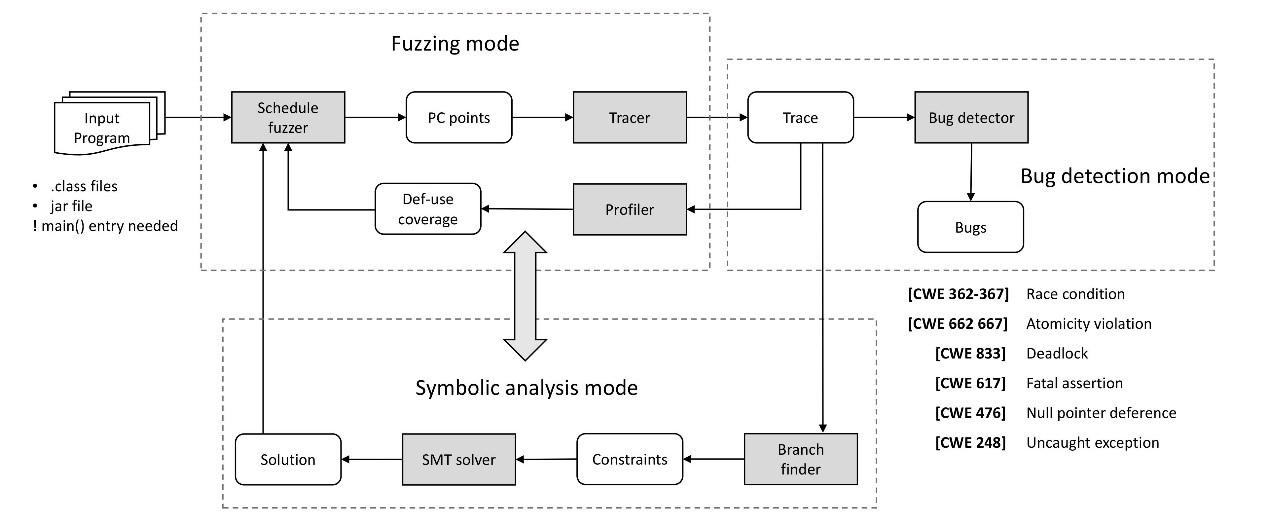
Concurrency defects hide in the interleaving of threads. A race that triggers once in 10^9 runs can still ship, and when it does the failure is often impossible to reproduce on demand. DATE-Confu tackles this by coupling guided schedule fuzzing, which explores the enormous state space of thread interleavings, with symbolic trace analysis, which identifies control branches the fuzzer has not yet reached. The symbolic information feeds back into the fuzzing loop, so each iteration targets unexplored code and coverage climbs faster than with fuzzing alone.
The tool takes JVM executables (.class or .jar files) as input and outputs the set of detected concurrency defects. It currently covers six defect categories: data races, deadlocks, null pointer dereferences, atomicity violations, order violations, and lock-related defects. Users choose which categories to detect based on their needs. DATE-Confu has been tested on multiple industrial-level projects, and those experiments showed both high testing efficiency and the ability to uncover deeply hidden defects.
The tool's credibility is backed by its recognition: it won second place in the Software Prototype Competition (Topic-based Category) at NASAC 2017, the National Conference on Software and Applications. The 2017 competition was the first to feature self-proposed topics, where contestants prepared their tools and conducted testing and reporting live at the competition site. Eight software tools passed the initial review and advanced to the final round, and a judging committee of industry and academic experts selected the winners.
If you're exploring how formal methods approach similar verification problems, see the team's related work on formal verification of smart contracts.
How Does DATE-Confu Instrument JVM Bytecode at Runtime?
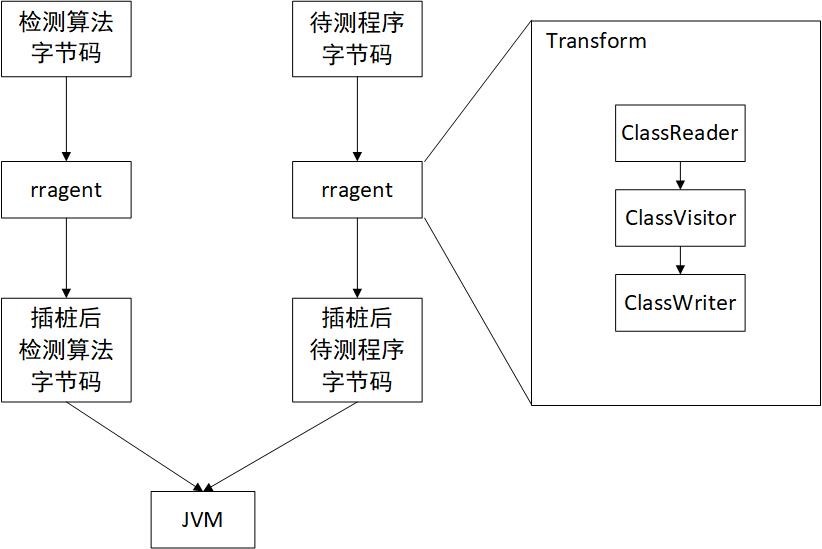
DATE-Confu instruments bytecode with the ASM framework via a Java Agent. ASM is a Java bytecode manipulation library that reads bytecode with a ClassReader, rewrites it through a visitor pattern, and emits new bytecode with a ClassWriter. The instrumented bytecode is then loaded into the JVM, where the inserted probes call DATE-Confu's detection algorithms at runtime.
The instrumentation happens in two phases. In the first phase, DATE-Confu uses the Java Agent pattern to instrument the bytecode of the detection algorithms themselves. In the second phase, when the module under test needs to be loaded into the JVM at runtime, the Agent's Transform method is invoked again to intercept that bytecode. After both phases complete, the instrumented bytecode is loaded and the running program triggers the detection algorithms through the inserted probes.
During instrumentation, the tool must avoid probing common Java modules, which would flood the output with noise. JDK modules are excluded inside the Agent's Transform method. The targets are the bytecode under test and the bytecode of the packages it depends on. This means the runtime classpath must expose those closely related packages, or the user must pass command-line exclusion flags to skip designated classes.
For a different angle on runtime tracing and instrumentation, see how ftrace selectively traces parent functions in the kernel.
The challenge of finding defects that only appear under specific schedules is not unique to application code. Regression testing strategies for concurrent code face a similar problem: how to exercise enough interleavings to catch race conditions without making test suites impossibly slow.
Why Isn't Random Thread Scheduling Enough?
The essence of fuzz testing multithreaded programs is introducing randomness into thread scheduling. The standard technique builds a userspace scheduler above the operating system that forces context switches, typically via sleep calls or priority changes. DATE-Confu uses priority changes specifically because they add low overhead and, unlike injected sleeps, do not introduce artificial deadlocks.
Most existing tools fuzz at the event level: they randomly insert a scheduling operation before or after a specific event, such as every memory write. The idea is that different threads will interleave differently across runs. The problem is that real applications contain enormous numbers of events, so the probability of hitting the exact interleaving that triggers a defect stays low. Event-level fuzzing wastes most of its runs on interleavings that exercise the same code paths.
DATE-Confu raises the hit rate with Memory Access Group (MAG) technology. The core idea is to group consecutive memory accesses and fuzz the scheduling only within each group. This narrows the state space dramatically, because the tool no longer searches across every event boundary in the program. But MAG alone is not enough to reliably generate defect-triggering traces. So the thread scheduling module models fuzzing as a search problem and applies the Monte Carlo Markov Chain (MCMC) method to guide the search toward promising schedules. The combination of MAG-based grouping and MCMC-guided search is what lets DATE-Confu find defects that event-level fuzzing misses.
How Does FastTrack Catch Data Races More Efficiently?
Classic Happens-Before detection logs every shared memory access and checks whether each one has a Happens-Before ordering relative to the previous access. If no such ordering exists, the two accesses constitute a data race. The approach is precise but expensive: maintaining and comparing full vector clocks on every access adds up fast. FastTrack, the algorithm DATE-Confu uses, keeps the same precision while cutting the cost dramatically. It does this by recognizing that most operations do not need a full vector clock at all.
The insight is grounded in how programs actually behave. In practice, thread synchronization operations are rare compared with the sheer volume of reads and writes that dominate race-detection work. FastTrack's key optimization exploits this: the full generality of vector clocks is unnecessary in the common case, so FastTrack uses a lightweight epoch-based data structure instead (FastTrack, 2009). The result is an order-of-magnitude speedup over traditional vector-clock detectors. The algorithm handles the three race cases separately: write-write races, write-read races, and read-write races. This hybrid scheme is what makes FastTrack both faster and more memory-efficient than classic Happens-Before, without sacrificing precision.
The chart below compares how different concurrency detection approaches trade off scalability and defect hit rate. DATE-Confu's guided fuzzing sits in the upper-right quadrant, combining strong scalability with a high hit rate.

How Can You Detect a Null Pointer Dereference Before It Crashes?
Null pointer dereference (NPD) defects, catalogued in detail in CWE-476, are among the most common crash causes in Java programs. In a concurrent setting they become harder to catch, because the dereference may only happen under a specific thread interleaving. DATE-Confu's NPD detection algorithm extends FastTrack to flag these defects before they crash the program.
The algorithm rests on two pillars: concurrency partial-order identification and memory sampling. It first identifies which operations across different threads have a strict Happens-Before ordering and which do not. Then it intercepts memory-access pairs that lack such an ordering, where one operation writes and the other reads. If either access involves a null reference, the algorithm flags a potential NPD, because concurrency non-determinism could cause that null reference to be dereferenced at runtime.
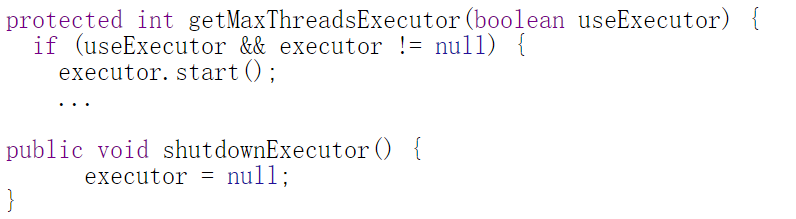
The detection flow runs as six steps. First, the tool dynamically loads the program's bytecode. Second, it instruments the bytecode by inserting memory-sampling probes keyed to specific JVM instructions. For the PUTFIELD instruction, for example, the stack top holds {value, objectref} representing the value to write and the object reference; the sampling probe captures that value. Third, the program runs and produces runtime traces. Fourth, the algorithm dynamically identifies Happens-Before relations between operations in different threads. Fifth, it intercepts memory-access pairs (x1, x2) that lack a Happens-Before ordering, with one write and one read. Sixth, it checks whether either access value is null, which signals a potential NPD in the concurrent environment.
The diagram below shows a concrete case: when a shared executor field is accessed by multiple threads, the NPD algorithm captures two concurrent pairs, (executor!=null, executor=null) and (executor.start(), executor=null), and memory sampling determines that the second pair can trigger a null pointer dereference.
Can You Predict Deadlocks Without Reproducing Them?
Yes. In a multithreaded program, a deadlock happens when every thread in a set holds a resource another thread in the set needs, forming a circular wait. Deadlocks are among the most common concurrency defects, and their impact ranges from increased response time and decreased throughput to full program crash. Like other concurrency defects, they are hard to expose, reproduce, and debug.
DATE-Confu detects deadlocks primarily through the GoodLock algorithm, which predicts whether a concurrent program can deadlock at runtime without needing to reproduce the hang. GoodLock constructs a lock tree for each thread, then connects those trees into a lock graph. It traverses all possible paths in that graph looking for cycles, and a cycle means a potential deadlock. The algorithm handles deadlocks among any number of threads, not just pairs. It also combines runtime detection with static analysis and implements a type system that provides stronger atomicity guarantees on top of the core deadlock detection.
Deadlock risks also appear in distributed systems that rely on shared state. The blockchain network simulation post explores concurrency hazards in a very different execution model. For readers building up their systems programming background, the learn Linux step by step series covers foundational concepts that underpin concurrent systems work.
Frequently Asked Questions
What concurrency defects can DATE-Confu detect? DATE-Confu detects six categories of serious concurrency defects: data races, deadlocks, null pointer dereferences, atomicity violations, order violations, and lock-related defects. Users select which types to target based on their testing needs. The tool accepts .class or .jar files and outputs the full set of detected defects.
How is guided fuzzing different from standard thread fuzzing? Standard event-level fuzzing inserts a context switch before every memory event, but real apps have so many events that the defect hit rate stays low. DATE-Confu's guided fuzzing groups consecutive memory accesses into Memory Access Groups and searches within each group using MCMC, which narrows the state space and raises the hit rate.
Why does FastTrack use epoch clocks instead of vector clocks? In practice, thread synchronization operations are rare compared with the reads and writes that dominate race-detection work, so full vector clocks are unnecessary in the common case (FastTrack, 2009). FastTrack uses lightweight epoch-based clocks for those cases, which cuts both time and space complexity while keeping the precision of classic Happens-Before detection.
How does GoodLock find deadlocks without reproducing them? GoodLock builds a lock tree for each thread, connects them into a lock graph, and traverses all possible paths looking for cycles. A cycle signals a potential deadlock, found through a combination of runtime monitoring and static analysis without needing to trigger the actual hang.
Can DATE-Confu analyze any JVM application? The tool takes JVM executables (.class or .jar) as input and instruments them via a Java Agent. It automatically excludes JDK modules during instrumentation and targets the under-test bytecode plus its dependencies. Users can also pass command-line flags to exclude specific classes.
Sources
- Flanagan, C. and Freund, S.N., "FastTrack: Efficient and Precise Dynamic Race Detection", ACM SIGPLAN Notices, Vol. 44, No. 6, June 2009 (PLDI 2009), https://dl.acm.org/doi/10.1145/1542476.1542496
- ASM, Java bytecode manipulation and analysis framework, https://asm.ow2.io/
- MITRE, "CWE-476: NULL Pointer Dereference", https://cwe.mitre.org/data/definitions/476.html
- National Conference on Software and Applications (NASAC), Software Prototype Competition, 2017